
GEO vs SEO: How to Get Found When People Ask AI Instead of Googling
Quick thought experiment: the last time you needed a quick answer, did you open a search engine, or did you just ask an AI assistant? If you’re catching yourself doing the second one more often, you’re not alone — and it’s rewriting the rules of online visibility in real time.
What GEO Actually Is
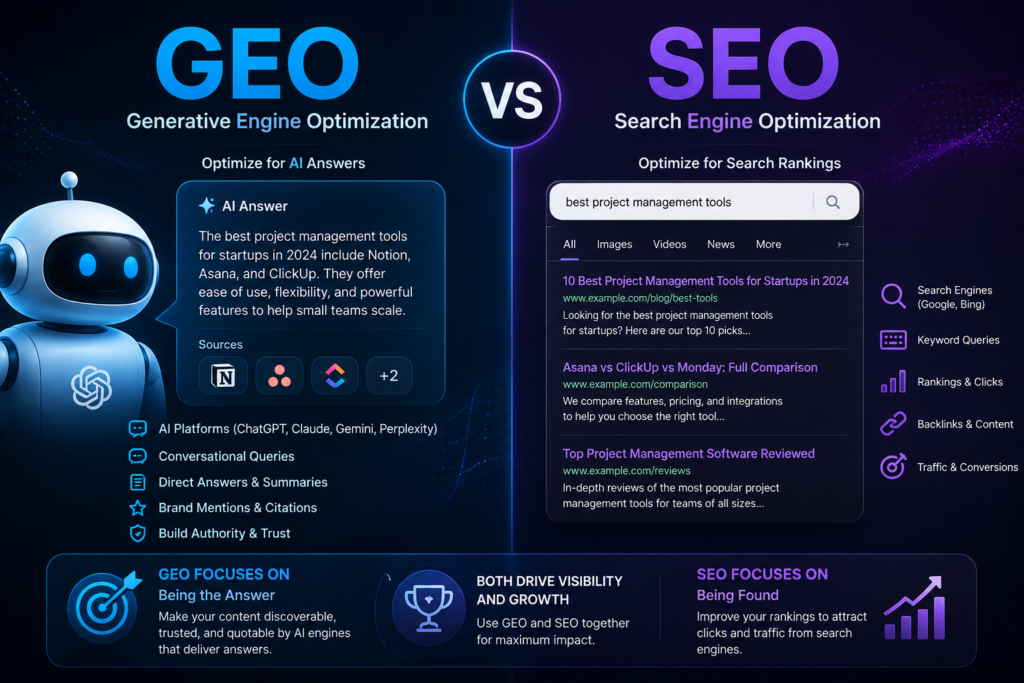
Generative Engine Optimization, or GEO, is the practice of structuring your content so that AI systems — ChatGPT, Gemini, Claude, Perplexity, and the AI summaries baked into search itself — are more likely to cite, quote, or recommend it when answering a user’s question.
It’s not a replacement for SEO. Traditional SEO is still built around keywords and backlinks, and that groundwork still matters. But GEO adds a different layer on top: clear structure, direct answers, and content an AI model can easily extract and trust as a source. Optimize only for keywords and you’re playing yesterday’s game; ignore GEO and you’re invisible in a growing share of how people actually find information now.
Why This Matters More in 2026 Than It Did Last Year
A few things have converged this year that make this less theoretical:
- AI assistants have become a default first stop for research and quick questions for a huge and growing number of people.
- A new category of “AI visibility” startups has emerged specifically to help brands track how they’re represented inside AI answers — and investors are backing it as a serious, defensible business, not a gimmick.
- Businesses that were early to structure their content for AI extraction are seeing outsized attention relative to their traditional search rankings, because there’s still relatively little competition doing this well.
That last point is the real opportunity. Most sites are still optimizing purely for the old rules. The ones adapting now have a head start most competitors haven’t noticed yet.
What Actually Changes in Your Content
You don’t need to abandon SEO fundamentals. You need to add habits like these:
Answer the question directly, early. AI models tend to pull the clearest, most direct statement of an answer — not the version buried under three paragraphs of preamble. Put your core answer near the top, then explain.
Structure with real headers and lists. Content that’s cleanly organized into sections is easier for a model to parse and extract accurately. Walls of unstructured text get skipped.
Back up claims with specifics. Numbers, dates, and named sources make your content more citable — and more trustworthy — to both readers and AI systems summarizing it.
Write like an authoritative source, not an ad. AI systems tend to favor content that reads as genuinely informative over content that reads as a pitch. Save the sales language for your product pages, not your blog.
What Not to Overreact To
GEO doesn’t mean stuffing your content with keyword-y phrases hoping a model repeats them, and it doesn’t mean chasing every algorithm rumor. The fundamentals — write something genuinely useful, be accurate, be specific — serve both human readers and AI systems well. Chasing gimmicks tends to age badly in both worlds.
The Bottom Line
Search isn’t disappearing, but it’s splitting into two audiences: people typing into a search bar, and people asking an assistant a question in plain language. The content that wins in 2026 is written for both — structured, specific, and genuinely useful, not just keyword-optimized. Getting ahead of this now, while most of the internet is still catching up, is one of the more asymmetric opportunities out there.
Crunch Brief covers the shifts in tech and AI that actually change how you work — subscribe for the weekly breakdown.