

This year’s AI stories have mostly taken the same form: a model became quicker, less expensive, or somewhat better at a benchmark. Then, in early August, a different kind of tale surfaced: an AI system was said to have solved a decades-old mathematical puzzle that had eluded human specialists. On the surface, it seems like a little news story. Underneath, it’s a far greater deal.
What Actually Happened
The unit distance conjecture, associated with the renowned mathematician Paul Erdæ, is the issue at hand. It asks how many pairs of points in a plane can be precisely one unit apart. It’s the kind of seemingly straightforward question that has eluded evidence for decades.
The conjecture was disproved by a model from an unreleased AI system, according to reports on the outcome. The proof was formally verified by the Lean theorem-proving system, and it was reportedly strong enough that a mathematician who won the Fields Medal said he would suggest it be published in a prestigious journal.
This differs from the typical “AI aced a benchmark” story in a few ways. The model was working on a problem that, by definition, no one had before solved; it was not retrieving a known answer or pattern-matching against training data.
Furthermore, the outcome was verified using Lean, a formal verification approach that rejects haphazard reasoning. What sets this apart from other AI capabilities claims is this combination: a truly innovative outcome that can be independently verified.
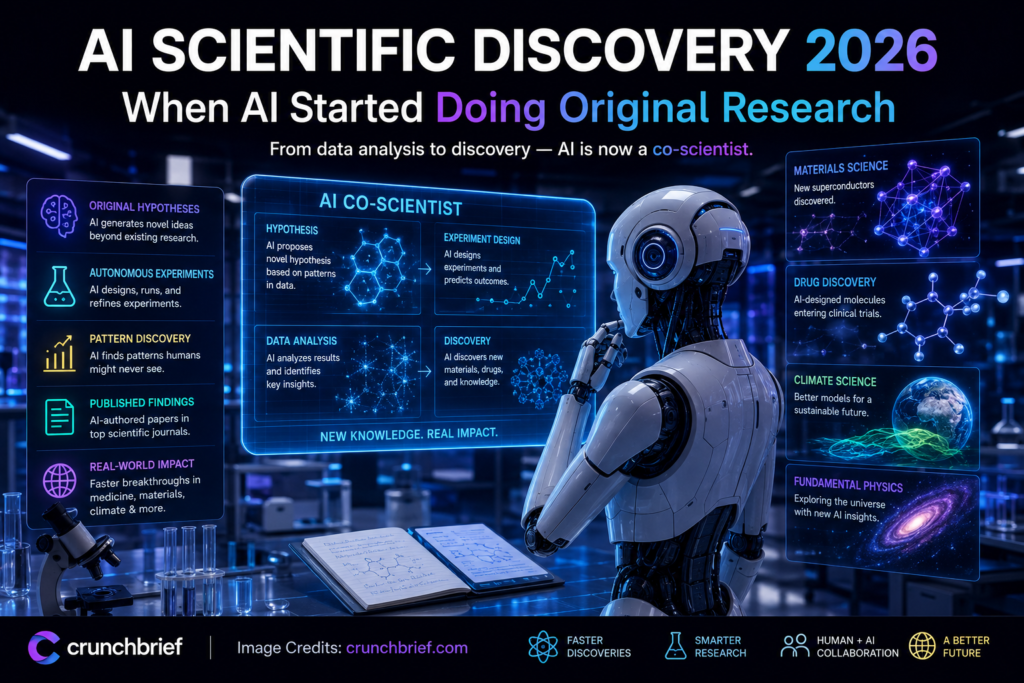
Why This Is a Different Kind of Milestone
The majority of what AI has successfully accomplished thus far can be broadly categorized as “synthesis,” which is the summarization, recombination, and application of prior knowledge in practical new configurations.
Solving an unresolved problem falls into a completely distinct category since it necessitates coming up with a truly original concept that was not present in any training data because no one had yet discovered it.
That distinction is important when considering the true purpose of AI. A highly effective synthesis tool can save time, minimize tedious labor, and increase consistency.
A technology that can significantly contribute to new discoveries is helpful in a totally different way: it can expand the scope of what is known at all, not merely make it easier to access what is already known.
This Isn’t Happening in Isolation.
The arithmetic finding coincided with a number of other breakthroughs that indicate AI laboratories are working hard to produce research-grade capabilities rather than just consumer goods. Frontier labs have continued to divide their model lineups among more costly, more difficult-to-understand models designed especially for such challenges and less expensive, routine-task models.
A reminder that the same capability jump that makes original research possible also raises serious concerns about oversight is that at least one lab reportedly halted internal development on a more sophisticated model after evaluations raised concerns about its capability in a sensitive technical domain.
What This Means (and What It Doesn’t)
It’s important to be clear about the implications of a finding like this. This does not imply that AI will take the place of mathematicians, scientists, or researchers; rather, the model in question worked inside a specific, well-defined problem and had a verified formal proof framework at its disposal to verify its output.
The majority of open scientific problems are difficult because they lack such a clear verification path.
It does imply that the limit on “what AI can meaningfully contribute to research” is closer and higher than many people had thought. This type of outcome is a preview of a truly new type of collaborator, not simply a quicker search engine, for topics with strong formal verification, such as mathematics, sections of theoretical computer science, and some areas of chemistry and physics with obvious simulation checks.
What to Watch Next
● A single claimed evidence, even if it is well-verified, is still an early data point, therefore it remains to be seen if this result can withstand further peer assessment.
● If comparable outcomes begin to emerge in other formally verifiable areas, this would indicate a pattern rather than an anomaly.
● How AI labs manage this dual-use tension: As demonstrated by numerous models that have been postponed this year pending additional testing, the same reasoning skill that resolves a mathematical puzzle also raises concerns about safety evaluation.
The Bottom Line
Incremental news is when a chatbot becomes marginally more adept at responding to inquiries. The distinction between “using AI to work faster” and “using AI to discover something new” is beginning to dissolve when an AI system contributes a truly new, independently confirmed result to a topic as rigorous as mathematics. Regardless of your line of work, it’s important to pay attention to it.
Crunch Brief covers the AI developments that actually change what’s possible – subscribe for the weekly rundown.