

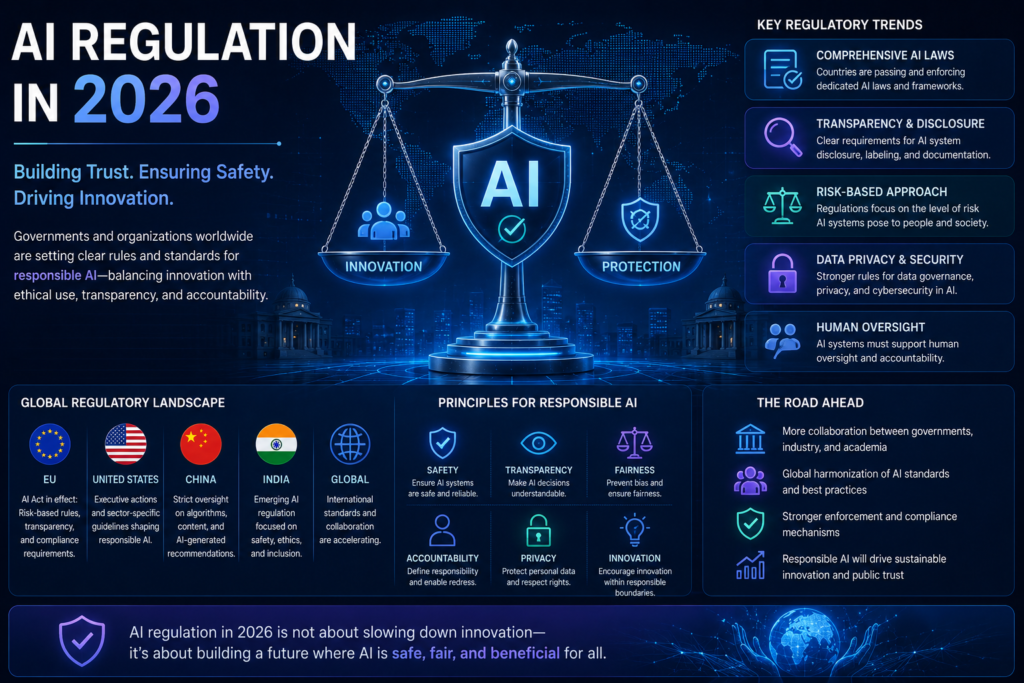
For a few years, AI regulation was mostly a conversation about the future draft frameworks, proposed bills, “watch this space” headlines. That conversation is over. In 2026, AI regulation is no longer theoretical, and if your product touches AI in any meaningful way, it’s worth understanding what actually changed.
The EU AI Act Is Now Fully in Force
The European Union’s AI Act has moved from phased rollout to full, strict enforcement this year, and it’s functioning as something close to a global default the way GDPR did for data privacy. Companies outside the EU are finding it easier to build to the stricter standard once than to maintain separate versions of a product for different markets.
For most tech companies, this means compliance isn’t a legal team’s side project anymore it has to be baked into the development process itself, especially for anything classified as “high-risk.”
The Geneva AI Accord: A New Global Baseline
Alongside the EU’s enforcement, more than 40 nations signed the Geneva AI Accord this year, establishing a shared framework for AI systems considered high-risk. The headline requirements are worth knowing even if you’re not a lawyer:
- AI systems used in critical infrastructure, healthcare, or law enforcement must include a working “kill switch” and a human-in-the-loop override.
- Real-time, untargeted facial recognition in public spaces by law enforcement is banned outright, with narrow, court-approved exceptions.
- Signatory nations are aligning enforcement, which reduces the old strategy of routing risky deployments through more permissive jurisdictions.
What This Actually Changes for Builders
If you’re building a product with AI features, the practical impact depends heavily on what your product does:
Consumer apps with light AI features (recommendations, content generation, chat support): Relatively low direct impact, though transparency expectations disclosing when users are talking to AI, for instance are tightening across the board.
Anything touching healthcare, hiring, credit, or law enforcement: This is where scrutiny is heaviest. Expect requirements around explain ability, human oversight, and audit trails that go well beyond “the model works.”
Infrastructure and enterprise AI tools: Increasingly expected to build in override and monitoring capabilities from day one, not bolt them on after a regulator asks.
Why This Might Actually Help Serious Startups
It’s easy to read all this as pure friction, but there’s a genuine silver lining for founders building real products. Clear rules favour companies with the resources and discipline to comply which sounds like it favour’s incumbents, but it also filters out the low-effort “thin wrapper” competitors that could previously ship fast and worry about consequences later. A start-up that treats compliance as a feature, not a burden, has a real story to tell enterprise customers who are increasingly asking vendors for exactly this kind of assurance.
What to Do Now
- Map which of your features would count as “high-risk” under either framework even if you’re not currently selling into the EU.
- Build human-override capability into anything making consequential decisions about real people, not as an afterthought.
- Document your AI decision-making process. Audit trails are becoming a baseline expectation, not a nice-to-have.
- Treat compliance as a selling point in enterprise conversations, not just a legal checkbox.
The Bottom Line
AI regulation stopped being a future problem sometime this year. The EU AI Act’s full enforcement and the Geneva AI Accord together set a global baseline that most serious tech companies will end up building to, regardless of where they’re headquartered. The founders and teams treating this proactively rather than reactively are the ones who’ll spend less time firefighting later.