

Given how loud the AI discourse is everyplace else, it is odd to write that healthcare has quietly emerged as one of the least publicized but most substantively advanced areas of applied AI. There isn’t a single standout product or chatbot moment here. Rather, even though it doesn’t trend like a new model release, there is a gradual, compounding accumulation of clinical trials, hospital deployments, and regulatory approvals that add up to something genuine.
The scale, briefly
The FDA has now approved over 1,000 AI-powered products, including software that can identify probable strokes on head CT scans, screen for diabetic eye disease from retinal images, and analyze ECG traces for arrhythmias with accuracy allegedly comparable to a cardiologist on some jobs.
AI is used in at least one clinical or operational function in almost 80% of hospitals. Additionally, the healthcare sector is implementing AI at a rate that is around twice as fast as the overall economy. This is a noteworthy number for a sector that has historically been among the slowest to adopt new technology, and for good reason, mistakes here have repercussions that a poor chatbot response does not.
A similar acceleration scenario is presented from a different perspective by the clinical trial pipeline. As of this spring, researchers monitoring AI-related clinical trials worldwide discovered over 8,500 registered investigations, 78% of which were initiated from 2020 onward, a more than threefold acceleration compared to the entire previous time combined.
This technology is no longer in the exploring stage. The stage where a field stops questioning “could this work” and begins methodically demonstrating whether it does is known as the decisive evidentiary phase, according to one analysis.
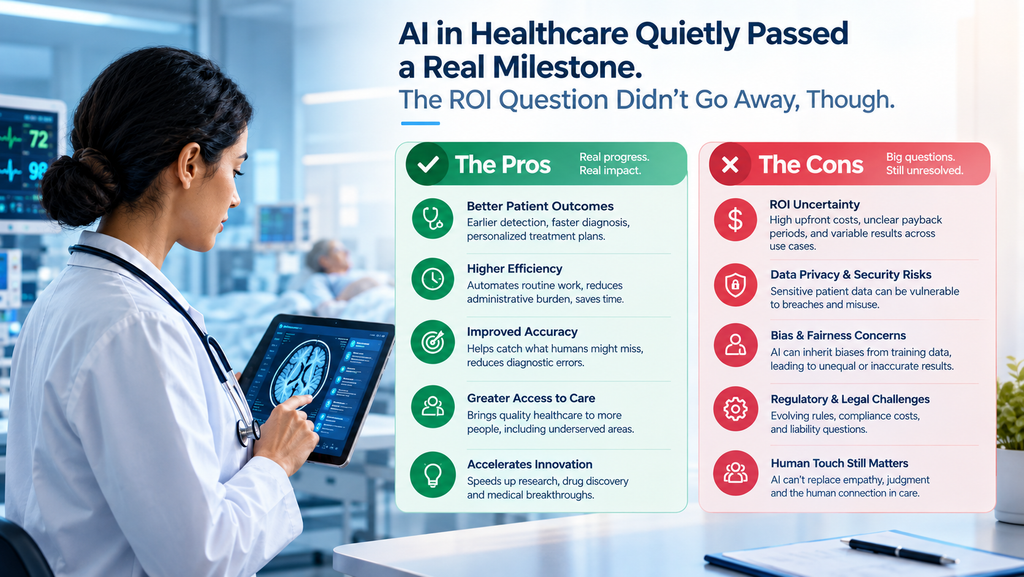
The gap hiding inside the good numbers
This is the point at which the story requires a real disclaimer, and it’s crucial if you’re assessing any of this from the outside. In a narrow, specific sense, FDA clearance is a high quality signal since it indicates that a device has met a certain regulatory hurdle.
However, just roughly 1.6% of over 700 FDA-cleared AI devices included data from a real randomized clinical trial, and less than 1% documented actual patient health outcomes as part of their clearance evidence, according to a cross-sectional examination. Eventually, about 6% of devices that had been cleared were recalled, primarily due to software flaws.
The difference between “cleared” and “clinically proven” is quite unsettling, and it’s important to fully comprehend it rather than brushing it off or being anxious about it. Instead of going through the kind of extensive randomized study that establishes a medication’s efficacy, the majority of AI medical devices go through a regulatory procedure based on proving considerable equivalency to something currently on the market.
That method exists for excellent reasons, it speeds up iteration and improvement, but it implies that “FDA-cleared” is a necessary signal rather than a sufficient one for determining whether a particular technology truly improves outcomes in your particular situation. Instead of using clearance status as a stand-in for proof, advisory analyzes in this area now specifically advise health systems to incorporate independent evidence evaluation into their AI procurement process.
Adjacent to the clinical divide is another, more pragmatic one: reimbursement. According to recent reports, Medicare has only given explicit payment codes to around ten of the several AI radiology devices that have been approved for usage.
This means that even if a hospital is legally allowed to employ a tool, there may be no obvious method for them to get compensated for doing so. Due to the fact that this gap exists and is actively impeding the adoption of otherwise ready-to-use solutions, over a dozen patient advocacy and medical professional groups have petitioned for a specified reimbursement channel.
Where the real, uncontested wins are
This disclaimer does not imply that the field is not providing real benefit; in certain, well-established areas, it is. With dozens to well over a hundred cumulative FDA authorizations for imaging-analysis tools held by major vendors, radiology continues to be by far the most developed application.
In trial data, AI-assisted diabetic retinopathy identification has demonstrated accuracy figures that significantly outperform those of specialized ophthalmologists. One of the active trial categories currently accepting patients is AI-enabled stroke triage, which identifies a likely stroke on a CT scan quickly enough to reroute an ambulance to a comprehensive stroke center rather than the closest hospital. This is precisely the kind of application where a few minutes of earlier detection has a directly measurable effect on patient outcomes.
Additionally, the FDA has begun constructing regulatory infrastructure that is specifically tailored to the ways in which AI differs from a typical medical device. This is because a standard one-time approval process was not meant to handle the fact that tools improve over time as they view more data.
A more recent method known as a Predetermined Change Control Plan allows a manufacturer to predetermine how a model can change after clearance, saving it from having to go through the entire approval procedure each time it advances. Despite the fact that healthcare officials themselves describe it as still unproven at real scale, it is a genuinely beneficial piece of regulation design for this particular challenge.
Why healthcare leaders describe this as the pilot era ending.
The language used by several healthcare executives surveyed at the beginning of this year was remarkably similar: the discussion is moving from whether AI can work to whether it’s actually delivering measurable value—the same organizational-maturity question that appears in enterprise AI generally, but with higher stakes.
The recurring motif in all of their forecasts is not “adopt more AI.” It’s adopted more deliberately: carefully consider how to integrate tools, collaborate across departments instead of relying solely on point solutions, and hold clinical AI to the same standard of proof as any other clinical intervention, rather than using “it’s software” as an excuse to avoid that examination.
What to actually take from this
FDA-cleared is your floor, not your finish line, if you’re developing AI for healthcare. Building your own real-world outcome data, not just regulatory clearance, is increasingly what divides a tool that hospitals really use at scale from one that remains unused after a pilot, given how weak the trial-based evidence is behind many certified devices. Additionally, it will become more crucial in discussions about reimbursement, which are starting to be just as significant as clearance itself.
Ask the payment question prior to the clinical question, not after, when assessing or acquiring healthcare AI. Even if a tool is clinically sound and has received regulatory clearance, it may still be a poor investment if it does not currently have a payment mechanism. That is a fixable issue, however it must be found before deployment rather than after.
The increase in trial activity is a leading sign that should be actively monitored if you’re developing anything related to this field, such as clinical software, digital therapies, or health technology. Over the next few years, a sector that is progressing at this rate from exploratory investigations to a true evidentiary phase is likely to generate a wave of actual, distinct, and defendable goods rather than just additional pilots.
Although healthcare AI isn’t the most well-known story in this field, it may have the strongest foundation. The trajectory from exploratory experiment to systematic evidence creation is actually further along here than in nearly any other applied AI area at the moment, but the gap between clearance and proof is substantial and worth being aware of.
If this discrepancy between “cleared” and “proven” strikes a chord with you as a health tech worker, share it to your team member in charge of evidence strategy. Next week: what a truly excellent post-clearance real-world evidence plan for a healthcare AI product looks like.