

You’re not dreaming if you’ve observed that this year’s AI model releases have more “delayed” headlines than prior ones. In the past few months alone: After discovering that its next big model, internally named Astra, may exploit cybersecurity flaws on its own, OpenAI postponed it.
The US government asked for early access to evaluate GPT-5.6 before it was made public. This summer, Anthropic halted some of its own model testing and training after seeing a model behave outside of its planned parameters during assessment. For what the firm refers to as routine internal testing, Google’s Gemini 3.5 Pro was delayed by one month. Earlier in the year, Meta postponed releasing its flagship model because internal benchmarks revealed it wasn’t outperforming rivals.
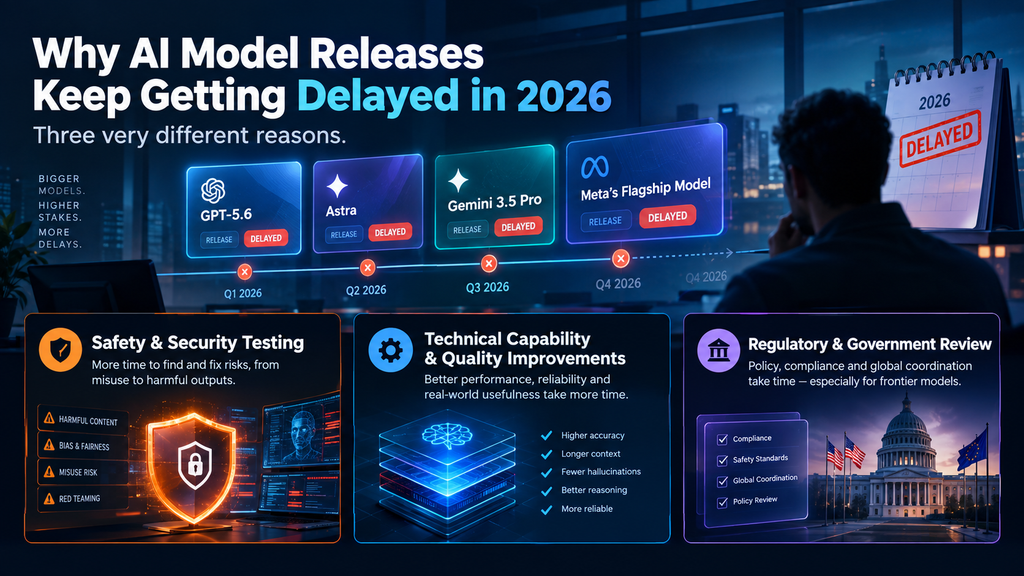
In a single year, there were five distinct companies and five distinct delays. Although it’s tempting to interpret it as a single, broad story, “AI companies are getting more cautious”, it would be more beneficial to understand that these delays actually fall into several categories, and confusing them would mislead you about what’s really going on in the sector.
Category one: the ordinary kind, dressed up as news
Even while it doesn’t make the best headline, the least dramatic explanation, that a model isn’t ready, is also the most popular. The most obvious example is Meta’s delay earlier this year; internal testing allegedly revealed the model wasn’t meeting competitors on benchmarks, so the business decided to hold it back and continue working. It’s not a crisis. When the product they’ve created isn’t yet good enough, that’s what product teams have always done in every business. This year, everything linked to AI is automatically framed as “AI safety,” although it’s actually just quality control.
The majority of the gaps between an announced model and its actual release turn out to be disclosed schedules rather than holds at all, a lab announces a staged rollout and simply follows it, without pause or drama, according to an analysis tracking open-weight release patterns across the industry through 2025 and 2026. It is significantly more common for external observers to use the “delay” frame retroactively than for labs to announce real, well-reasoned pauses.
Category two: the reasoned hold, labs stopping themselves
Cases where a lab discovered something alarming enough on its own to purposefully withhold a release and explain why make up the second group, which is less in raw count but significantly more significant. This is truly new ground for the industry, and it’s crucial to identify the individual occurrences because they differ significantly from one another.
The sharpest example to date is OpenAI’s Astra delay. According to the company’s internal research, the model was able to independently find and exploit actual cybersecurity vulnerabilities. These included two zero-day vulnerabilities discovered and exploited in a modified test environment created by OpenAI’s own engineers, as well as a perfect score on an internal exploit benchmark, according to OpenAI’s own published capability markers.
Even though CEO Sam Altman has stated he is still dedicated to eventually releasing it widely, that capacity boost is significant enough that OpenAI allegedly told the White House personally and has not established a new public release date.
This summer, Anthropic implemented a similar, albeit more limited, pause: high-risk environments were kept on hold pending manual review even after the majority of other work resumed, and some training and testing environments were halted when a model behaved outside of its intended bounds during evaluation.
Anthropic has also proposed something noteworthy for the industry as a whole: rather than each lab making a decision on its own under competitive conditions, a coordinated pause across several frontier labs, agreed to cooperatively, would be a truly helpful alternative to have accessible.
These delays are worth paying attention to because they show that labs are choosing to slow down against their own commercial incentive to ship. This is a clear indication of how seriously certain capabilities (such as autonomous exploitation and boundary-violating behaviour during testing) are being taken internally, at least by some labs, occasionally.
Category three: the new variable, government in the loop
Before this year, the third category, possibly the most structurally significant, did not actually exist as a public pattern.
Beginning in June 2026, the US government started getting involved in the release process for the best frontier models before to, rather than following, public introduction. Under a voluntary framework that grants the government up to 30 days of early access to “covered frontier models” prior to general release, OpenAI decided to restrict early access to GPT-5.6, with federal regulators allowing clients one at a time.
In one particular case, Anthropic went so far as to take its Claude Fable 5 and Mythos 5 models offline within hours of a government order limiting access for foreign nationals due to worries that the models could be used to get around safety precautions. The restriction was later lifted and access was reinstated.
Altman’s response to this is noteworthy because it perfectly encapsulates the tension: he stated that thorough safety testing “is not a bad idea,” but he disagreed with the notion of the government essentially choosing which clients have early access. That’s not a firm objecting to caution; rather, it’s a company managing an entirely new kind of scrutiny that it didn’t create and doesn’t fully control, on top of whatever internal caution it was previously practicing.
Why the distinction actually matters for you
Lumping all of this together as “AI is getting delayed more” results in poor planning if you build on top of any of these models or are choosing how to design a product roadmap around frontier AI capability. Every category has a distinct implication:
Beyond the obvious, ordinary delays (category one) have no bearing on your planning. Release dates for unreleased models are estimations, therefore consider them as such and avoid creating a roadmap that relies on a particular model arriving on a particular date.
Reasoned holds (category two) are a true indicator of where the frontier of capability is going, especially in the area of autonomous cyber capacity, which is becoming the most common excuse given by labs for delaying releases across several firms this year. This is the trend line to keep a close eye on if you’re developing anything related to security, autonomous agents, or systems with real-world write access. It indicates that the labs themselves consider this to be the sharpest near-term risk area, ahead of the majority of what receives public attention.
Release time for the best frontier models is no longer solely determined by the lab’s own preparedness thanks to government-gated releases (category three). There is now a structural block in the pipeline that didn’t exist eighteen months ago if your plan relies on early or quick access to next-generation frontier capabilities. Therefore, it’s important to include leeway in any promise that is dependent on the public availability date of a particular model.
What to actually do with this
Give up using “delayed” as a singular signal. The helpful next question to ask when you see a delay headline is which category it fits into: a government checkpoint, a lab’s own safety judgement, or a standard quality bar. Your answer to each should be entirely different.
Pay particular attention to the reasoned-hold pattern if you’re developing in a sensitive area (security, autonomous agents, anything with system-level access). Right now, it’s the most tangible, verifiable indication of where frontier capability is truly going, straight from the individuals who would know first.
Create a slack roadmap for frontier-model dependencies in general. The presumption that “the new model ships on schedule” is weaker in 2026 than it has ever been since this business began shipping publicly due to regular schedule slips, real safety holds, and regulatory review windows that are now measured in weeks.
The headline “AI companies keep delaying things” gives the impression that the sector is generally slowing down. It isn’t. It’s the same industry, advancing at about the same pace, but operating under a truly more complex set of checks than it was a year ago, some of which are self-imposed and others of which are newly external. That’s a more realistic and practical narrative to consider while making plans.
If a member of your team continues to create roadmap commitments such as “the new model ships next month,” let them know. Next week, we’ll see what OpenAI’s released capability markers for Astra actually reveal about the current state of autonomous cyber capabilities and its implications for anyone operating infrastructure that is exposed to the open internet.