

When you seek for AI-in-education data, you’ll encounter the same obstacle as when you search for AI cybersecurity figures: dozens of websites that use various polls, base rates, and definitions of “using AI,” frequently contradicting one another on the same page. According to one source, adoption rates among students are 86%, 88%, 92%, and 94% in the UK. Consider the precise percentage to be noise.
There is no question about the underlying signal, which is consistent across surveys conducted by the Digital Education Council, Stanford HAI’s AI Index, RAND Corporation research, and a report commissioned by Coursera, among others: in about two years, student AI use has increased from a minority behaviour to nearly universal, and the adults in charge of the classroom haven’t kept up.
The shape of the gap, from credible sources specifically
A few of these figures are notably worth referencing because they are derived from named, methodologically stated research rather than unsourced aggregator content.
92% of students and 79% of faculty actively use AI, according to the Digital Education Council’s 2026 Latin America higher education study. This represents a significant increase from the 86% student adoption identified in its 2024 global survey. That is not a static photo, but actual, measured movement over a period of two years.
On the K–12 front, a RAND Corporation poll of more than 3,000 teachers and Stanford HAI’s AI Index both reveal the same underlying trend from a different perspective: weekly teacher AI use in US classrooms approximately tripled, going from roughly 10% in 2024 to roughly 32% in early 2026. Teachers between the ages of 25 and 34 utilise AI technologies at significantly higher rates than teachers 55 and older, although this gap has been closing.
Furthermore, according to a 2026 report on higher education commissioned by Coursera, which is more recent than most of the others mentioned above, 95% of students and instructors currently utilise AI on campus in some capacity. However, only roughly 25% of educators worldwide reported feeling truly prepared to use it effectively. It is worthwhile to spend the most time with that final figure.
The actual finding, stated plainly
Strip away the conflicting adoption percentages and the actual fact is this: usage blew up considerably faster than institutional readiness did. Students embraced AI in a manner similar to that of most new tools: they did it quickly, casually, and mostly without seeking approval or direction. Institutions and educators are catching up, but integrated program design, policy, and training are far behind actual use rather than just a little behind.
The training gap stands out across multiple independent sources: the vast majority of K-12 teachers in the United States report receiving no formal AI training at all, and the majority of teachers currently using AI tools describe themselves as self-taught, improvising policy in real time rather than adhering to institutional guidance. That is not a criticism of individual teachers; rather, it describes an entire sector being pushed to incorporate a genuinely new type of technology with virtually no structural support for doing so successfully.
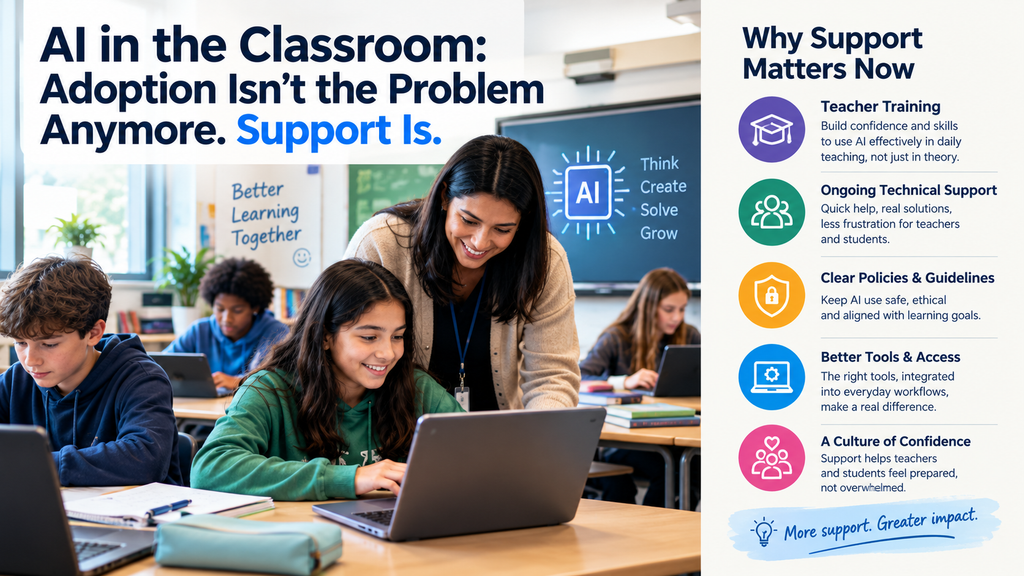
Why the informal versus structured gap matters more than the adoption number
Researchers have found that schools with formal, program-level AI integration report significantly higher and more consistent adoption than schools that leave it up to individual teachers to figure it out on their own. This difference is roughly three times higher in schools running structured programs compared to ad hoc, teacher-by-teacher experimentation. This finding should actually change how schools and edtech companies approach this, rather than just restating how quickly adoption is growing.
That’s an important, actionable distinction, because it means the lever here isn’t “more AI tools” or “more enthusiasm.” It’s institutional structure, training, shared policy, a program design that doesn’t leave every individual teacher reinventing how to use this responsibly from scratch. The schools getting real value aren’t the ones with the most enthusiastic early-adopter teachers. They’re the ones that built a program around the technology instead of letting adoption happen by accident.
The trust and integrity problem sitting underneath the adoption numbers
Adoption ahead of institutional readiness has a predictable outcome, which is evident in the research: most students express genuine concerns about the fairness of AI-based assessment, and a significant portion of faculty report genuine concerns about AI undermining critical thinking and research skills.
Additionally, it is widely acknowledged that AI-detection tools for academic integrity have become functionally unreliable at this point. This is a real, largely unresolved issue for any institution still attempting to police AI use with a detection tool rather than redesign assessment around its existence.
Both of those worries are valid, and interestingly, they don’t really conflict with the high utilisation rates. Despite their genuine concerns about fairness, fully two-thirds of students report having a generally positive opinion of AI in their education. People want to be able to be able to use guard, guard, guard, guard, guard, guard, guard, guard, and still want to use, and still want to continually. That blanket blanket blanket blanket blanket blanket blanket blanket blanket blanket blanket space.
What this means if you’re building edtech
Because it’s less crowded than other AI writing or tutoring tools, the training-and-support gap presents a greater potential if you’re developing a product for educational institutions. The market is crowded with point-solution AI solutions competing for individual teacher attention.
On the program-design side, it is considerably thinner, structured rollout frameworks, integrated teacher training, shared policy templates, and support for assessment redesign that enables an institution to implement AI cohesively as opposed to teacher-by-teacher. A solution that sells the structure instead of simply another tool has a genuine, untapped advantage in a market where everyone else is taking a tool-first strategy, since structured programs are already measurably outperforming ad hoc adoption.
What this means if you’re a school leader or administrator
Three things worth prioritizing this term, based on what’s actually differentiating the schools getting real results:
Build a program, not a policy document. A one-page AI policy that nobody got trained on produces the same ad hoc, self-taught outcome as no policy at all. The three-times adoption gap between structured and unstructured rollouts is the clearest evidence available that implementation design matters more than the policy’s content.
Invest in teacher training specifically, not just tool access. Giving every teacher an AI tool license without training is the single most common pattern in the data, and it’s also the pattern most associated with inconsistent, low-confidence use. The gap between “has access” and “feels prepared” is almost entirely a training gap, not a tooling gap.
Redesign assessment rather than trying to out-detect AI use. Every source touching on academic integrity in this space converges on the same conclusion: detection tools are losing this race. The schools managing this well are shifting toward assessment formats, in-class work, oral defences, process documentation, that make the detection question less central, rather than continuing to invest in tools that are already functionally behind.
The honest summary
The “AI in education” story isn’t really about whether students and teachers are using AI anymore, that question is settled, emphatically, across every credible source. It’s about whether the institutions around them build the structure to make that use good, rather than just fast. That’s a solvable problem, and the data on structured-versus-ad-hoc adoption already shows what solving it looks like. Most schools just haven’t done it yet.
If you work in a school or ed-tech company watching adoption outpace readiness firsthand, forward this to whoever owns your AI rollout. Next week: what a structured AI integration program actually looks like term by term, borrowing from the schools already three times ahead of everyone else.