

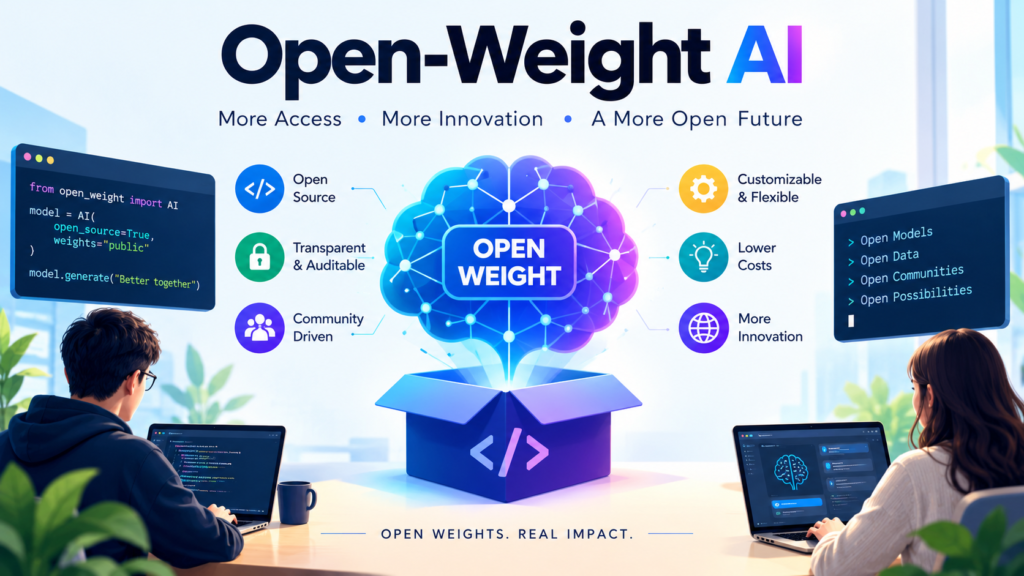
A kind of the open-weight versus closed-model discussion has been going on since 2023, and it’s primarily an ideological proxy war about who will rule AI in the future, whether a small number of labs should have this much authority, and other such issues.
That is a legitimate debate that should be held someplace. But when you’re choosing what to actually build your product on, that’s not the conversation you need to have. The majority of the founder-facing advice on that decision is still stuck relitigating 2023, and it became much more clear this year.
The gap closed faster than most roadmaps assumed
On the majority of key capability benchmarks, the performance difference between the best open-weight models and the best closed, proprietary ones had reportedly decreased from more than a year to as little as a few months as of earlier this year.
This August, Meta will ship an open-weight model that is purposefully positioned against its own more potent closed model that is hidden behind an API. This is the clearest public indication to date that even the labs developing both types view them as serving genuinely distinct functions rather than a hierarchy where open is merely the least expensive option.
The headline is that. More important is the fine print.
Open weight is not “open source”, and that distinction has teeth
The issue that many of the “just go open source” recommendations ignore is that what is referred to as open source in AI discussions is frequently actually open weight, and those are not the same commitment.
Open weight allows you to download and run the trained parameters on your own. Typically, this does not entail receiving the training code, training data, or a detailed explanation of the model’s construction.
Additionally, many of these models are delivered under unique licenses with actual use limits rather than the conventional freedoms that the word “open source” has meant in software for thirty years.
It’s not pedantry. What you’re really signing up for is altered. You’ll have to backtrack if your procurement or compliance team hears the term “open source” and assumes complete transparency and unlimited use rights. Before creating a plan based on a model’s openness, read the actual licence.
The framework that’s actually holding up
Set aside the ideology and the decision gets simpler. It comes down to a handful of practical questions:
Where is your private information kept? The issue can be resolved before quality even comes up if you’re working with material that is legally or contractually restricted to your own environment. The version of “AI” that allows you to tell a regulator or an enterprise customer exactly where their data goes is self-hosting an open-weight model inside your own infrastructure.
What’s your actual volume? This is the point at which people’s received wisdom turns against them. At low or erratic demand, closed APIs are usually the more affordable and straightforward option because they require no infrastructure to operate and no security personnel.
However, as volume increases, the cost math tends to reverse: open-weight models have lower marginal cost per request but higher upfront infrastructure costs. As a result, what appears costly at low volume can appear inexpensive at scale, and what appears inexpensive at low volume can subtly turn into your largest line item once you’re running it thousands of times every day.
Do you actually have the team to run it? Despite appearances, self-hosting is consistently more costly and operationally complex. While many developers are somewhat familiar with open-source tools in general, very few are truly capable of fine-tuning, deploying, and maintaining a model at production scale.
Consider not only the model’s licence fee, which is frequently $0, but also the actual cost of establishing or hiring for that knowledge if it isn’t currently present on your team.
How much does peak reasoning quality matter for this specific task? For some workloads, the best closed models can still have a significant advantage over open-weight alternatives on the most challenging reasoning issues. Paying for frontier quality is typically justified if the task is low-volume and high-stakes, where a long, methodical approach is acceptable and an incorrect response is costly.
The pattern worth adopting: stop picking a side
If the founders get this right in 2026, they won’t decide on an open or closed corporate identity. They are operating a portfolio: open-weight models for the high-volume, commodity-feeling work where cost effectiveness and data control are more important than squeezing out the final few points of benchmark performance, and closed frontier models for the few high-complexity, lower-volume tasks where peak performance justifies the cost.
In practical terms, this could mean running an open-weight model in your own environment for a customer support classifier that runs tens of thousands of times a day and touches data you’d prefer not to send anywhere, while using a top closed model for a research or reasoning-heavy feature that runs a few hundred times a day. The same product, two distinct versions, selected for two distinct purposes, not to prevail in a debate over which side is correct.
What to truly look at before making a decision
Examine this brief list before committing to your next feature:
• Does this task involve data that is restricted from leaving your environment by contracts or regulations?
• Does the math support self-hosted infrastructure or a per-token API at your realistic volume in six months?
• Do you have the team to protect and manage a self-hosted model, or are you willing to hire someone?
• Does “good enough, cheap, and fast” win this challenge, or are the final few points of reasoning quality worth paying for?
The open-versus-closed debate becomes what it should have been all along, a dull, task-specific engineering decision, if you answer those four questions for each task, not once for your entire organization.
Send this to the person in charge of the open vs. closed argument if your team has been mired in it for longer than it should. Next week: what goes wrong when a production feature is moved from a closed API to a self-hosted open-weight architecture, and what you are not informed about until halfway through the process.