

Ten people will confidently disagree if you ask them if AI is creating or eliminating entry-level jobs. The real situation in 2026 is genuinely divided, and knowing why is far more important than taking a side. This is not because the data is flawed.
The Case That AI Is Shrinking Entry-Level Jobs
The negative data is accurate. According to Stanford research, entry-level hiring has decreased by 13%, particularly in positions with high generative AI exposure. Separately, according to a study of business executives, almost 60% of firms intend to make layoffs in 2026, with many pointing to automation and artificial intelligence as major factors.
Employers are only anticipating a slight increase in hiring for the Class of 2026, despite the fact that more graduates than ever before are joining the workforce, making it difficult for recent grads.
The Case That AI Is Growing Entry-Level Hiring
However, a sizable portion of the business sector is presenting an entirely different picture. According to a global poll, 67% of CEOs predicted that AI will boost entry-level hiring in 2026, and senior talent leaders were almost three times as likely to believe that AI would increase entry-level hiring than decrease it.
IBM made this clear by announcing intentions to increase its US entry-level recruiting in 2026. This is specifically because AI technologies now take care of the basic coding tasks that junior employes used to spend the majority of their time on, freeing them up for higher-judgment jobs sooner.
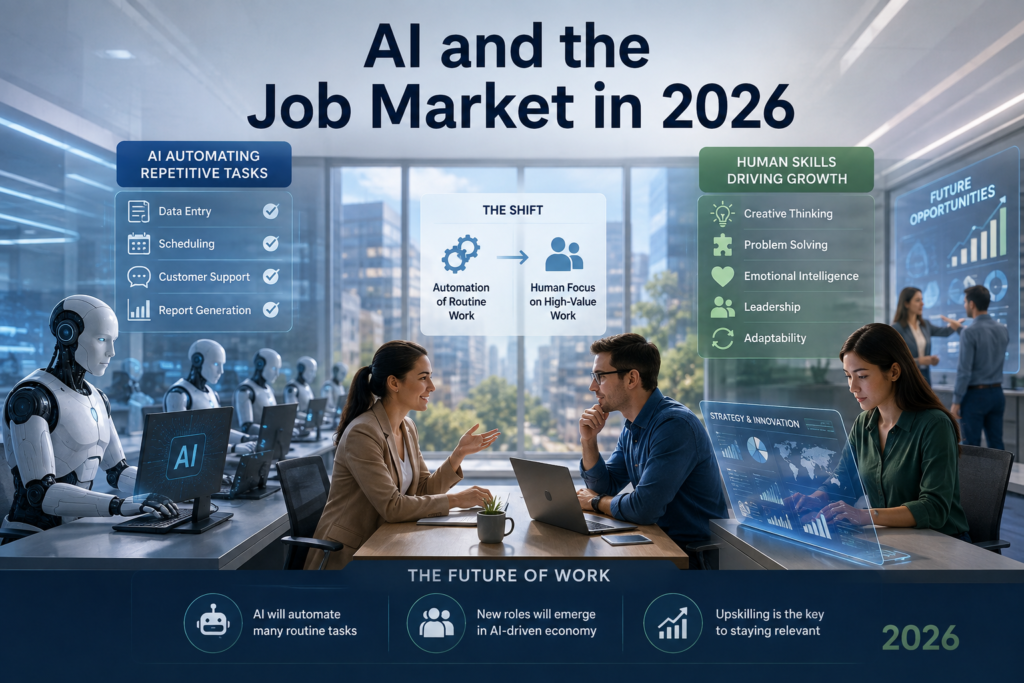
How Both Things Can Be True at Once
The answer is that AI is dividing the labour market into two paths rather than advancing it in a single direction, not that one dataset is incorrect. This is a “two-track” labour market, according to research from PwC’s global jobs analysis: jobs where AI automates routine tasks and increases the amount of human judgement needed are expanding, while jobs where AI merely makes the current job easier for anyone to perform without requiring any additional judgement are contracting.
In actuality, this implies that entry-level positions that were pure execution, routine data input, easy first-draft writing, and basic triage, are disproportionately disappearing. The entry-level positions that are expanding are those that are being redesigned around problem-solving, judgement, and client engagement, with AI taking care of the mechanical aspects underneath.
What Employers Actually Say They Want Now
A few consistent signals show up across recent surveys of hiring managers and executives:
- A large share of entry-level job postings now explicitly list AI-related skills as a requirement, and that share has been climbing fast year over year.
- Roles that survive AI exposure tend to demand meaningfully higher “soft” skills – judgment, communication, and cross-functional collaboration – not just technical fluency.
- Companies redesigning entry-level roles are deliberately stripping out the most automatable tasks and rebuilding the job around what’s left, rather than just cutting headcount.
What This Means If You’re Early in Your Career (or Hiring Someone Who Is)
- AI fluency should not be viewed as a differentiator; rather, it should be treated as a table stakes.
- Seek out positions and organisations that discuss “redesigning” entry-level work rather than merely “cutting costs with AI,” as this indicates the direction a job is taking.
- Before thinking AI eliminates the need for a headcount, think about if a position is truly pure-execution (a category that is diminishing) or judgment-plus-AI-leverage (a category that is expanding).
- Pay attention to the skills gap rather than merely the headcount figures. According to studies, a significant portion of organisations anticipate key skills shortages even tho total hiring figures are questionable.
The Bottom Line
The truthful response to the question, “Is AI killing entry-level jobs?” is that it is, generally speaking, eliminating one type of entry-level employment while simultaneously producing another. The contradicting, perplexing headlines reflect two actual trends occurring at the same time, not a data error. The real risk is to base your hiring strategy or career on only one side of the story.
Crunch Brief covers how AI is actually reshaping work, not just the headlines – subscribe for the weekly breakdown.