

There are currently two concurrent stories about AI and jobs, and most coverage combines them into one, making them both more difficult to comprehend. Story 1: Businesses are making news when they announce layoffs due to AI. The second story is that there hasn’t been a discernible movement in employment between companies that use AI and those that don’t, and one of the most thorough analyses of the entire economy revealed that the U.S.
occupational mix isn’t changing any more quickly than it did when the PC and the internet were introduced. Both of these are true simultaneously, and if you’re assembling a team, it’s important to comprehend why they don’t conflict.
What the layoff numbers actually show
Businesses have declared almost 50,000 layoffs this year that are directly related to AI, making up a sizable portion of all layoffs recorded thus far in 2026. That is true, yet rather than being distributed equally throughout the economy, it is concentrated excessively in the tech industry in particular.
Because AI takes up a significant portion of what junior jobs used to perform, the majority of AI’s actual impact isn’t senior staff being replaced, they’re actually difficult to replace, but rather a decrease in the hiring of juniors, according to a labour economist’s analysis.
Before making a layoff decision based on AI promises, it’s also important to be aware of a less positive trend in the data: a sizable portion of businesses that laid off employees citing AI capabilities are reportedly regretting it, sometimes because they eliminated positions based on AI capabilities that didn’t really exist at the necessary level.
Rather than acknowledging that the first cut was premature, some of that gap is covertly filled by rehiring, frequently offshore and at a lesser cost. If you’re thinking about reorganising around an AI feature, it’s important to be open about whether you’re betting on a roadmap or if the capability is demonstrated in your particular workflow right now.
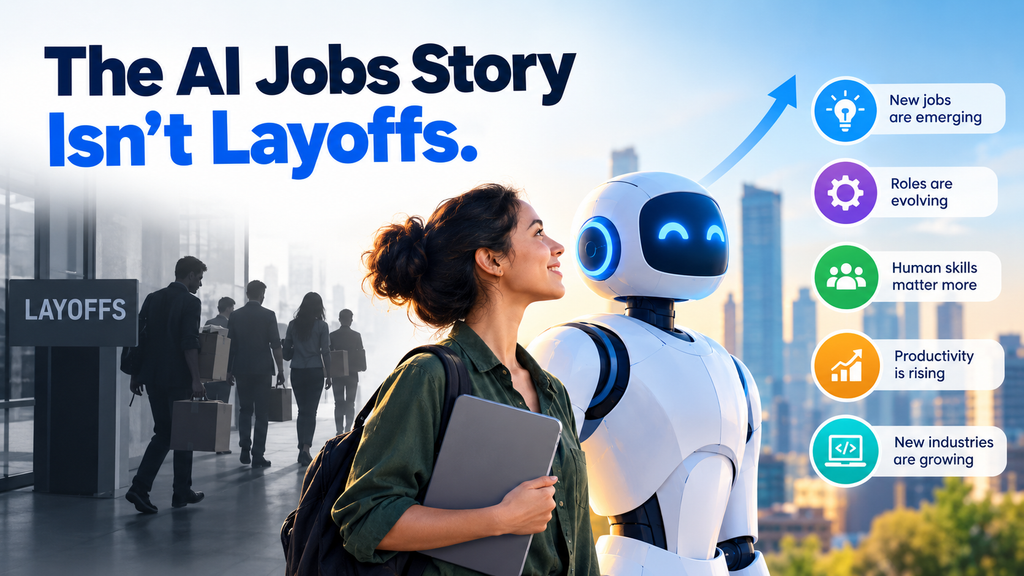
The quieter story: the rung that never gets posted
This pattern is easy to overlook because it doesn’t garner as much attention as a layoff announcement. A job request that is missing doesn’t make news. It appears as though nothing happened for a team that just never opens the junior role this quarter. However, for someone in their early career, it’s the same lost opportunity, and there is concrete proof that this is occurring on a large scale.
Once you recognise it, the process is simple: the jobs that AI currently excels at, such as writing, summarising, first-pass research, and boilerplate programming, substantially overlap with the things that junior workers have traditionally been employed to perform as they gain experience. The entry-level position for such task is not created in the first place if a senior employee with AI support can handle that amount of work without assistance.
Hiring cycles for graduates are shifting later and later in the year as employers wait to see if they need to fill the role at all, there is a documented decline in high-exposure entry-level job postings, and junior developer hiring has decreased by 20 to 30% at some companies, according to multiple analyses.
If you’ve simply read the headlines about layoffs, this is actually counterintuitive. The mass-substitution narrative that “AI is replacing workers wholesale” is not yet well-supported by the larger employment data. “AI is quietly shrinking how many entry points exist” is the missing-rung story, which has far stronger backing and a structurally distinct problem with a structurally different solution.
Why this matters even if you’re not hiring juniors right now
Since you most likely don’t have a sizable graduate hiring pipeline, this may seem like someone else’s problem if you’re an early-stage startup. For two reasons, it’s still worthwhile to comprehend.
In a few years, it will change the skill pool from which you will hire. The pipeline of experienced mid-level talent will look different in five years if fewer people are receiving the entry-level reps that were once utilised to develop baseline competency. It’s a slow-moving issue, but it’s the kind that’s far less expensive to prepare for in advance than to deal with once you start looking for a job.
It’s a sneak peek at what occurs within your own team as you grow. Your third or fourth engineering hire is just as directly affected by the same dynamic that is reducing entry-level posts at major companies, a senior employee plus AI-absorbing tasks that used to warrant a new recruit, as is a Fortune 500 graduate program. It’s worthwhile to ask if the next position you’re going to publish is genuinely a job or if your current team could handle it with improved AI-assisted workflows.
What to actually do with this
A few practical takeaways, whether you’re building a team of five or fifty:
Raising the bar consciously is preferable to completely skipping the rung when hiring junior talent. According to the research, firms are expecting juniors to operate at a level that used to take a few years to reach, AI-augmented from day one, rather than abolishing junior roles. Be clear about what “junior” means now compared to two years ago in both your job posting and your onboarding if you choose the rung is worth preserving in your organization.
Avoid reorganising around AI capabilities that you haven’t verified in your own processes. Because businesses wager on a roadmap rather than a proven outcome, the rehire-after-regret pattern manifests. Before deciding on a headcount, test the particular task you plan to automate.
The missing rung is real if you’re in your early career and reading this, but it’s concentrated in positions that are created around the same things that AI already excels at. The reframe is worthwhile: as a junior hire, your value proposition should increasingly include “I can direct and check AI output effectively,” rather than merely “I can do the underlying task manually.” That’s a skill that can be learned, and it’s the one that now appears in the data as a salary premium rather than a consolation prize.
Because layoffs are visible and noticeable, they will continue to make news. The part that is truly worth watching is the rung that silently stopped being constructed; it’s slower, less noticeable, and most likely going to be more significant.
Send this along to a team member who is in the early stages of their career and wants to know what they should really concentrate on at this time. Next week: a role-by-role look at what “AI-augmented junior” really looks like in real life.