

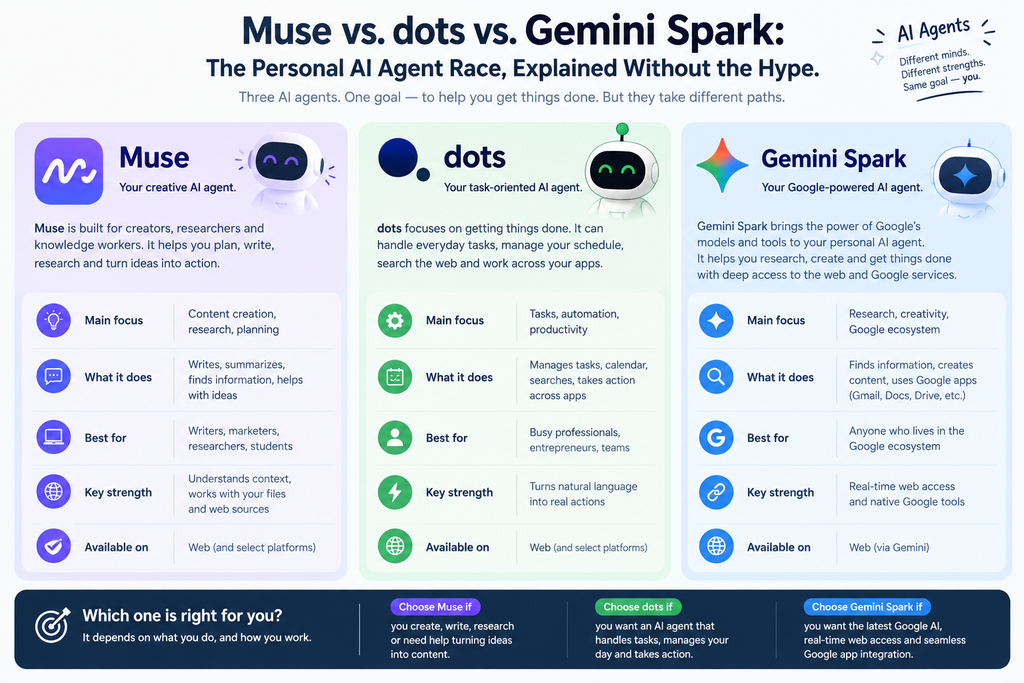
For almost two years, “AI agent” primarily referred to a demo that performed well on stage but poorly at home. It began evolving into a product category with names, mascots, and monthly payments this autumn. Muse was introduced by Meta on September 8. On September 29, OpenAI released Dots. Back in May, Google had previously demonstrated Gemini Spark. The phrase “another day, another autonomous assistant with a cute character attached” was used by one trade media to sum up the atmosphere.
The branding is absurd. It’s not the shift beneath it. These tools don’t wait to respond to enquiries. They set a goal, work on it in the background on their own computer, and report back. Here’s an easy-to-understand tour of what your phone will be doing for you next year, whether you’re a business owner, product developer, or just curious.
Meta’s Muse: the one built to shop
Meta’s personal agent is called Muse. With a free tier and two subscription plans, Power at $20 per month and Maximum at $100 per month, it debuted on iOS, Android, the web, and WhatsApp. According to Meta, it is a private, safe agent that offers suggestions and assists individuals in achieving their objectives. In reality, it can plan travel, send emails, start a browser, complete forms, and check out on your behalf. Instead of operating on your device, it operates on a separate virtual machine. Meta promises that it doesn’t send talks or that machine’s data to its advertising systems.
Meta says it doesn’t pass conversations or that machine’s data to its ad systems, which is a promise worth watching over time.
The majority of Muse’s initial focus was on the payments aspect. According to Stripe, Meta connected Link, its agent digital wallet, to Muse. According to reports, Stripe can create a one-time virtual card up to the authorised amount for retailers who do not accept Link. Additionally, in mid-September, Meta launched a connector platform where developers provide an API and Muse provides the agent, browser, and context of the user’s request.
John Collison, president of Stripe, stated on a webcast that by October 5, Muse had 2.18 million daily users. A partner with a stake in the narrative made that claim, and one media pointed out that he withheld the underlying figures. Consider it an indication rather than a confirmed number.

Ray-Ban Meta (Gen 2) Wayfarer, Matte Black, Clear lenses
Get more done and stay connected without reaching for your phone with AI glasses powered by Meta AI. Capture video recordings, translate…
OpenAI’s dots: an always-on colleague
On September 29, OpenAI revealed dots at their DevDay keynote. With its own cloud computer and browser, each dot in ChatGPT is a personal agent driven by the GPT-6 Astra model. You give it a name, link the apps you want it to interact with, and establish guidelines for when it may act on its own and when it needs your permission. You can access it via Teams, Slack, or ChatGPT, and it continues to function in between discussions. Texting is indicated as coming later, and voice calls function upon launch, but a dot cannot initiate a call to you.
Compared to Muse, access is more limited. Only the more expensive versions (Pro and Business Premium, plus enterprise) come with one dot at launch. According to certain reports, the EU, Switzerland, and the UK will not be included in the Pro rollout at this time. On the same day, OpenAI declared that ChatGPT now has 1.2 billion weekly users and unveiled a $500 monthly subscription.
Noteworthy: When discussing AI release delays, we already discussed the Astra model. The fact that it is currently running inside dots shows how rapidly a “held back” model may become a product.
Google’s Gemini Spark: the quiet third
Gemini Spark was introduced by Google in May, ahead of both competitors, but it has received significantly less attention than Muse or Dots. I was only able to determine that it existed and belongs to the same race since I couldn’t locate enough trustworthy information about its present deployment. Instead of depending on comparison posts when assessing agents for your team, look through Google’s own documentation.
A quick side-by-side
| Muse (Meta) | dots (OpenAI) | |
|---|---|---|
| Launched | Sept 8, 2026 | Sept 29, 2026 |
| Where | iOS, Android, web, WhatsApp | ChatGPT, Slack, Teams |
| Price | Free; $20 and $100 tiers | Higher-tier plans only at launch |
| Strength so far | Consumer tasks and shopping | Long-running work, team tools |
| Control model | Connectors, payment approvals | Rules for when to act vs. ask |

Owl Labs Meeting Owl 3 – 360° 1080p HD Conference Room Camera, AI-Driven Speaker
The Meeting Owl 3 is an all-in-one video conferencing device that captures 360° video in 1080p HD and 360° audio up to…
The trust problem nobody has solved
If I were choosing whether to let one of these to access my accounts, this is where I would slow down.
First, customers are cautious. Only roughly 14% of respondents trust an agent to make a purchase without a person validating it, according to a survey included in coverage of Stripe’s data. The consumer is asked to approve the total for each purchase in Stripe’s consumer flow for Muse.
Second, banks are resisting. According to reports, JPMorgan and Charles Schwab both prevented unauthorised agents from accessing customer accounts; Schwab claims to reject attempts on a weekly basis. An agent logging in as you could not be accepted by your bank.
Third, no one has decided who is responsible for paying when an agent purchases the incorrect item. According to a PYMNTS poll, 93% of retailers believe the loss should be covered by the AI or agent provider. To the best of my knowledge, no significant AI company has officially acknowledged that.
The hype is balanced with one additional figure. According to Stripe, agent-driven payments via Link increased 38 times in September, with an average purchase of about $100 and a 20-fold increase in volume. Although it began from a very little base, it is a real jump.
Where startups can find room
Big labs build the agents. They can’t build everything around them. A few gaps look genuinely open:
- Connectors. Muse’s connector platform invites outside developers to plug in services. If your product has an API and a clear use case, being easy for an agent to use is becoming a distribution channel.
- Approval and audit tools. Businesses will want a record of what an agent did, with what permission, and a way to roll it back.
- Liability and fraud tooling. With nobody owning the loss, whoever can price and insure agent mistakes has a real business.
- Verticals. OpenAI’s specialist dots for companies are still at the pilot stage. Narrow, industry-specific agents are less crowded than general ones.
What to do this month
Try one agent on low-stakes activities first, keep approval prompts enabled, and avoid connecting a bank or work account that you can’t afford to have handled improperly if you’re a customer or small team. See what happens to your data when you disconnect an app. According to OpenAI, uninstalling an app prevents fresh access, but it doesn’t automatically remove the data that the dot has already stored.
If you’re developing, choose one agent platform, deploy an integration or connector, and assess whether it attracts actual clients before growing.
There is a real agent race that is outpacing the safety regulations. For the time being, it makes sense to be inquisitive, start small, and keep a human finger on the button.
Please forward this to everyone you know who has been wondering whether to try Muse or Dots. Next week: an hour-long lesson on how to draft a “what my agent is allowed to do” policy for a small team.