

This August, if you’ve spent any time on founder Twitter (or whatever we’re calling it this month), you’ve undoubtedly heard the headline stats being circulated: AI startups are receiving the bulk of all venture capital funding worldwide, with two companies alone accounting for a startling share of it. It’s the kind of figure that causes early-stage innovators to experience two emotions at once: a persistent worry that the money isn’t really reaching them and sincere delight that the category they gambled on is having a moment.
That anxiety, it turns out, is worth paying attention to.
The headline number and what it’s actually made of
In the first half of 2026, global venture capital reached almost $510 billion, with over 70% of that amount going toward AI alone in the second quarter.
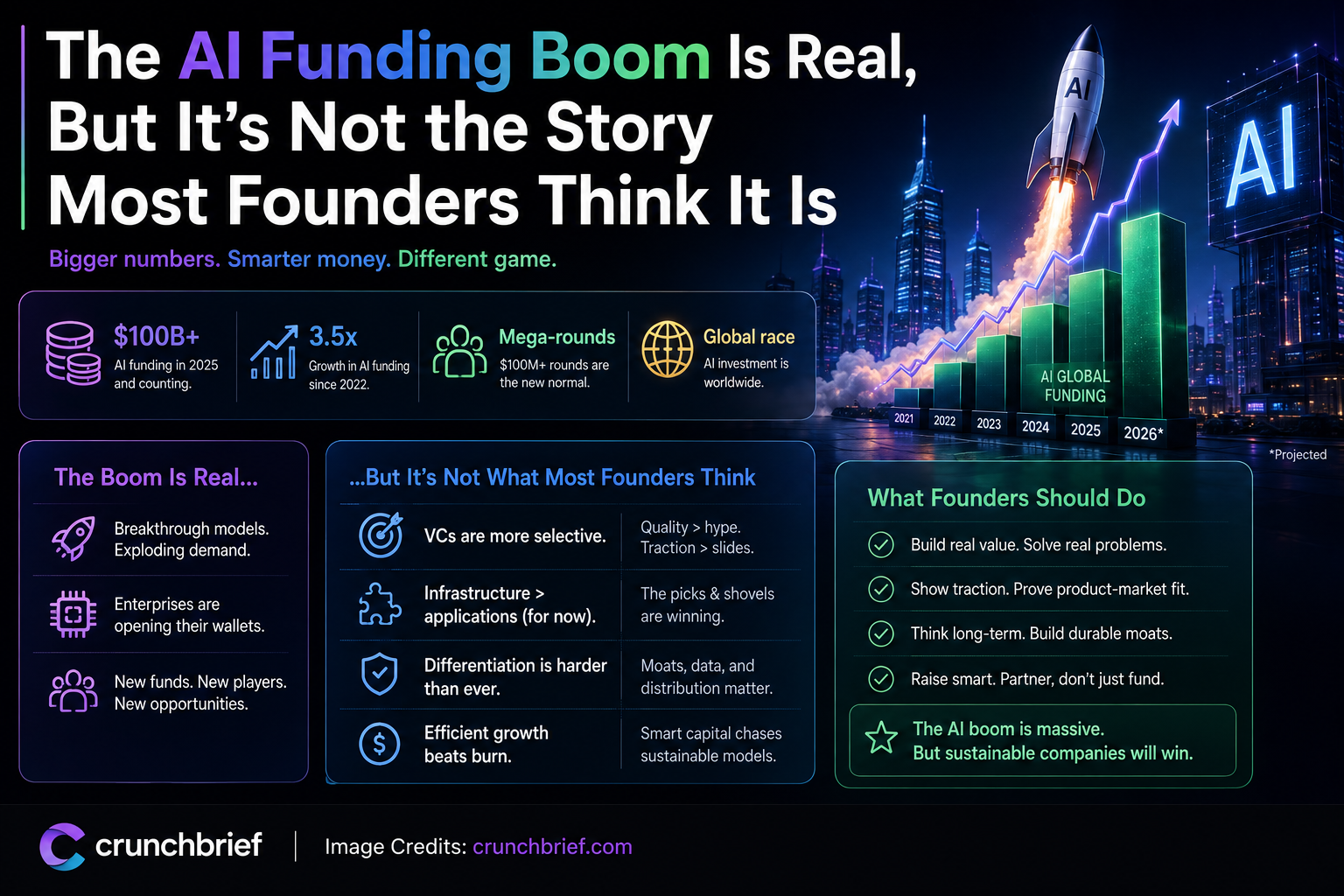
the internet.According to reports, almost 40% of all venture capital funds used during that window went to two companies, the typical suspects that everyone in this industry is already familiar with. The concentration has only become worse, as seen by the fact that AI’s full-year share in 2025 was nearly half of all investment.
If you’re not one of those two businesses, here’s what matters: this market is characterized by a small number of massive transactions rather than by a growing tide that improves the lot of every AI startup. The actual number of businesses receiving funding, or deal volume, hasn’t changed all that much. The dollar amount increased not because more founders are receiving funding, but rather because a few checks became ridiculously enormous.
The “AI is eating venture capital” narrative can be purposefully deceptive if you are currently raising a seed or Series A. It implies that investors are funding anything that has a model. They’re not. They’re asking everyone else to present their work while putting massive sums of money at a small number of businesses that have shown, long-lasting advantages.
Where the real money is actually going
A clearer image appears when the mega-rounds are removed. Outside of the largest labs, capital is concentrated in a few key areas: healthcare, legal tech, computation and infrastructure, and other regulated businesses where AI performs costly, high-stakes tasks that still require human intervention. In many industries, “good enough” chatbots are insufficient because the cost of an error is so great that users will pay for a solution that is truly dependable.
You’re not out of luck if your startup falls outside of those areas. It indicates that generic placement won’t pass the higher “prove it” bar.
What investors are actually asking for
If you speak with anyone investing in AI businesses this year, you’ll find that they have a standard list of requirements before investing:
• Users who pay, not simply those who sign up. Usage figures that don’t include income read more like a demo than a business.
• A specific, limited workflow. Instead of pitching “AI for X industry,” the firms receiving funding are pitching a single, difficult task inside that business that they have fully automated. Data rights are safeguarded.
•You should anticipate this inquiry during the initial meeting if your solution relies on data that you do not control or have a legitimate relationship with.
• A sales motion that can be repeated. A case study is one large logo. Investors can underwrite a pattern of three comparable logos closing in the same manner.
Observe that the model you are using is absent from that list. Which foundation model fuels your product is no longer a question. Sometime around 2025, that question vanished. They want to know what you’ve developed around the model, such as the distribution, workflow, and guardrails, as that’s what a rival can’t replicate by registering for the same API.
The pitch that’s actively working against you
If the opening line of your deck is still “we use AI to help [industry] do [broad thing faster],” you are presenting the precise kind of business that isn’t currently receiving funding. Investors have witnessed enough generic-chatbot pitches to be unable to recognize the pattern from the first slide.
The awkward translation is that while the AI financing boom is true, it was never going to be your funding boom simply because you developed an AI-powered product. When you can demonstrate a specific issue, a paying clientele, and a reason why a well-funded incumbent can’t simply duplicate you in a weekend, it becomes your financing boom.
What to actually do with this
Asking three questions about your own business is a more beneficial activity than monitoring top-line financing figures if you’re planning a raise in the coming months.
- Can I provide statistics to support a certain, limited task that I’ve automated more effectively than a human performing it by hand?
- Do I have three instances of the same type of consumer making a purchase for the same reason, rather than three unrelated logos?
- What would be unique about my business that a well-funded rival couldn’t duplicate in a quarter if they created a comparable tool tomorrow?
The funding situation is really favorable for you right now if you can provide detailed answers to all three. Capital is flowing, and investors are aggressively searching for businesses that fit this description. You shouldn’t panic if you can’t yet. It’s a justification for investing the next several months in developing the proof rather than refining the pitch.
The funds are present. Simply said, it’s more selective than the headlines suggest.
Did you like this? Send it to a founder who is planning to launch a data room; if you want the next week’s issue to delve more into the construction of the “narrow workflow” pitch, click respond.