

“AI for accounting” largely referred to a more intelligent spreadsheet autocomplete a few years ago. It no longer implies that. The technologies listed below can now automatically classify transactions, reconcile bank feeds overnight, create reports that are ready for clients, and in some situations, conduct first-pass tax research. Instead of undertaking the tedious job from scratch, a human will review the results.
Here are some truly worthwhile uses of AI in 2026 for accountants, bookkeepers, and finance leads who are asking where AI truly makes its place in this industry (and where it still requires a cautious human eye).
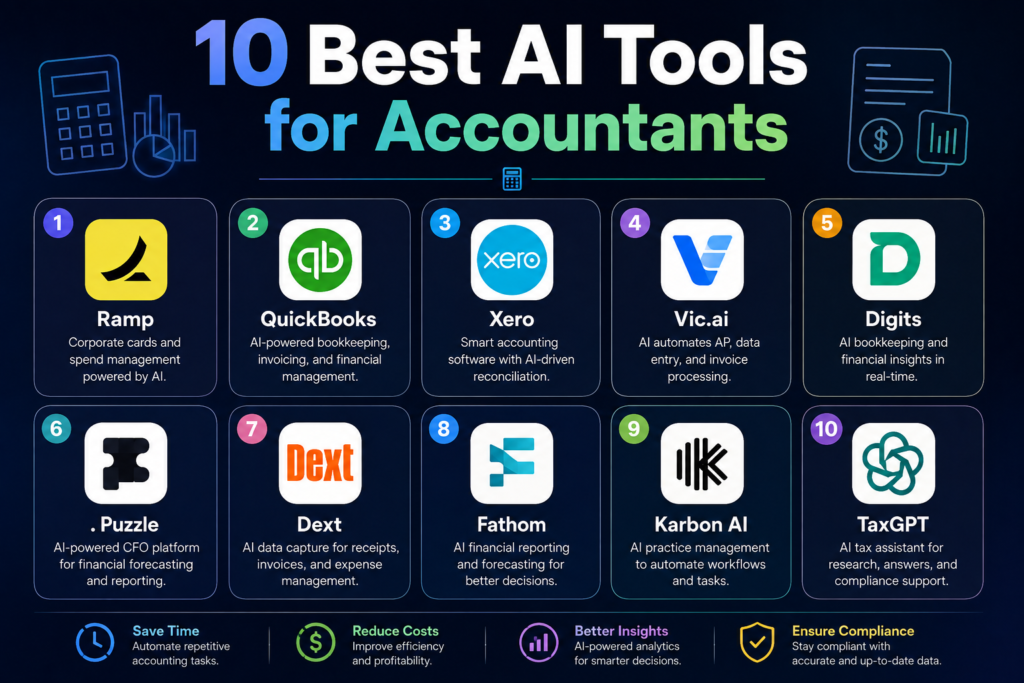
1. Ramp — AI agents for expense coding and close
Corporate cards and expenditure management helped Ramp establish its reputation, but the true story here is their accounting agent. Every transaction, including GL, department, class, location, and custom data, is initially coded as soon as it posts; there are no rules to set up.
Nothing enters your ERP without your approval, and each decision is accompanied by a confidence score and a justification. Compared to rules-based tools, businesses that use it report a significantly faster close and a substantially larger share of transactions coded automatically.
Best for: Finance teams that want AI handling first-pass coding across a high transaction volume, with humans reviewing exceptions rather than everything.
Pricing: Free to start on the core platform; advanced automation features scale with usage — check current vendor pricing.
2. QuickBooks Online (with Intuit Assist) — the familiar tool, now genuinely smarter
A significant portion of small businesses still use QuickBooks by default, and its AI layer, Intuit Assist, has advanced much beyond simple auto-categorization. Instead of waiting for a manual report, it now highlights irregularities, creates financial summaries, and displays cash flow insights.
A significant learning curve for teams unfamiliar with the platform and subscription fees that may seem excessive for very small enterprises are the trade-offs.
Best for: Firms and small businesses already in the Intuit ecosystem who want AI layered onto a tool their accountant already knows.
Pricing: Tiered monthly plans; AI features included in mid-to-upper tiers.
3. Xero (with JAX) — conversational AI for everyday bookkeeping
The conversational aspect of bookkeeping is handled by Xero’s AI assistant, JAX, which can answer enquiries about your books, automate repetitive tasks, and enhance AI-driven bank matching to reduce the amount of manual comparison required for reconciliation. For businesses looking to add an AI layer without completely changing their accounting stack, it’s a great option.
Best for: Bookkeepers and small firms who want AI-assisted reconciliation and a conversational interface for routine questions.
Pricing: Monthly subscription tiers; JAX features included on standard plans.
4. Vic.ai — enterprise-grade invoice and AP automation
Vic.ai specialises in accounts payable; it employs machine learning that gets better the more bills it reads, codes, and routes for approval. It’s designed for volume; companies who process more than a thousand invoices per month are in the sweet spot. Most businesses use it in addition to their primary accounting platform because it is a point solution rather than a complete general ledger replacement.
Best for: High-volume AP teams that want to stop manually coding invoices one at a time.
Pricing: Custom enterprise pricing based on invoice volume.
5. Digits — an AI-native general ledger built from scratch
With rapid reconciliation and automated month-end close, Digits develops the general ledger around AI from the ground up, eschewing the “bolt AI onto old software” strategy. Although it lacks the complexity necessary for intricate multi-entity consolidation or sophisticated revenue recognition, it is a good choice for small and mid-sized companies seeking a contemporary architecture.
Best for: SMBs and growing companies that want a modern, AI-first books platform rather than an AI add-on to legacy software.
Pricing: Starts around $65/month; scales with company complexity.
6. Puzzle — a QuickBooks alternative for startups
With continuous reconciliation and a genuinely speedier month-end close, some vendors use around 50% faster close times as a benchmark, Puzzle was created especially for start-ups and the companies that support them. Although it isn’t made for intricate, multi-entity companies, it connects with the technologies that start-ups now utilise.
Best for: Startup-focused bookkeepers and finance teams that want a true QuickBooks replacement.
Pricing: Subscription-based; pricing scales with transaction volume.
7. Dext — AI-powered receipt and document extraction
Dext concentrates on the unglamorous but crucial process of precisely extracting data from bills, invoices, and receipts and then elegantly feeding it into your accounting platform. It routinely ranks among the most dependable document-capture tools in the category, but it’s frequently used in conjunction with a full GL tool rather than by itself.
Best for: Firms drowning in paper receipts and PDFs who need clean, accurate document extraction before anything else works well.
Pricing: Tiered plans based on document volume.
8. Fathom — AI-generated financial commentary and reporting
The most notable feature of Fathom is its Commentary Writer, which transforms unprocessed financial data into narrative commentary for client-facing management reports using artificial intelligence.
This type of writing used to take up a significant portion of an advice accountant’s workweek. It usually sits on top of your current accounting software because it is a reporting and analytical layer rather than a bookkeeping tool.
Best for: Advisory-focused accountants who spend real time writing client reports and want a faster first draft.
Pricing: Subscription pricing based on number of companies managed.
9. Karbon AI — practice management with AI built in
Karbon is a practice management software for accounting firms that tracks work, deadlines, and client communications. It incorporates artificial intelligence (AI) to summarise email threads, create client updates, and highlight issues. It’s more about managing the business well around the numbers than it is about the numbers themselves.
Best for: Firms that want AI help managing workflow, deadlines, and client communication, not just the accounting itself.
Pricing: Per-user monthly pricing; contact vendor for current rates.
10. TaxGPT — AI-assisted tax research and prep support
Fast client intake, support for Schedule C categorisation, and AI-assisted research on tax code questions that previously required manually searching thru reference materials are all features of TaxGPT, which was created especially for the tax side of the practice.
It functions best on clean, well-organised client data, just like all other tools in this category; complicated entities and non-standard scenarios still require the judgement of a human expert.
Best for: Tax preparers and CPAs who want faster first-pass research and intake during busy season.
Pricing: Subscription pricing; check current vendor site for tiers.
A Few Honest Caveats
Clean, standardised data is ideal for all of the tools on this list. There is currently no AI technology that can take the role of human judgement when it comes to messy books, atypical entities, intercompany transactions, and non-US tax circumstances. It’s important to evaluate a platform’s handling of a purposefully mismatched transaction before committing to it. A smart tool will flag the transaction for review rather than silently posting it.
The Bottom Line
The accountants who are making the most of AI in 2026 aren’t using it to replace their judgement; rather, they are utilising it to eliminate monotonous tasks that used to take up their week, freeing up more time for analysis and client interactions that genuinely call for a human. Instead of attempting to rebuild your entire stack at once, choose one or two tools that address your biggest bottleneck first.
Crunch Brief covers the AI tools actually worth your time — subscribe for weekly, practical coverage.