
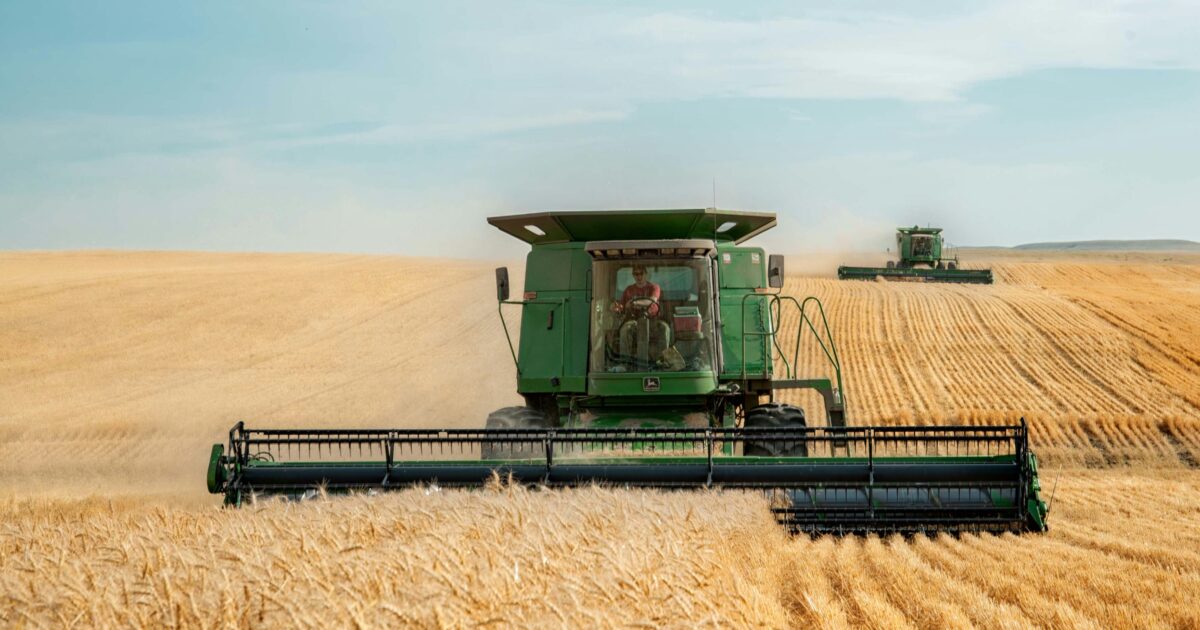
In contrast to chatbots and coding agents, agriculture typically doesn’t make the AI news, which is a little odd considering the amount of money and actual deployment that occurs in this field. As part of a larger $7 billion agtech financing total in 2025, precision-agriculture deals surpassed funding for crop inputs and upgrades last year. Press releases and pilots do not fall under this category. Real farms are currently using autonomous tractors, robotic weeders, and satellite-driven yield prediction in real fields on a commercial scale.
Silently, it’s also one of the most obvious instances in any industry of a technology that works flawlessly for those who can buy it while hardly reaching those who most need it.
What’s actually running in fields right now
Most individuals outside the sector are unaware of how many AI applications are currently being used for business purposes. Instead of doing sporadic physical inspections, crop and soil conditions are continuously monitored by satellite and Internet of Things-based technologies. In addition to reducing waste and expenses, variable-rate spraying systems distribute pesticides and fertilisers precisely where they are needed rather than evenly throughout a field.
Animal health signs that a human could not continuously monitor are tracked via livestock biometric monitoring. Decisions are now made further up the supply chain than just at the farm level thanks to the direct integration of yield-forecasting models into breeding and procurement pipelines.
Autonomous weeding is the particular technology that is receiving the most attention this year; it is a truly excellent example of artificial intelligence (AI) resolving an issue that was previously resolved with pesticides.
Individual weeds can now be identified and removed without the use of herbicides by tractor-mounted systems that use cameras and lasers; actual deployments claim about 90% identification accuracy and positioning precision within a few millimetres. That is a production specification from equipment that is now in use in commercial fields, not a lab demo number.
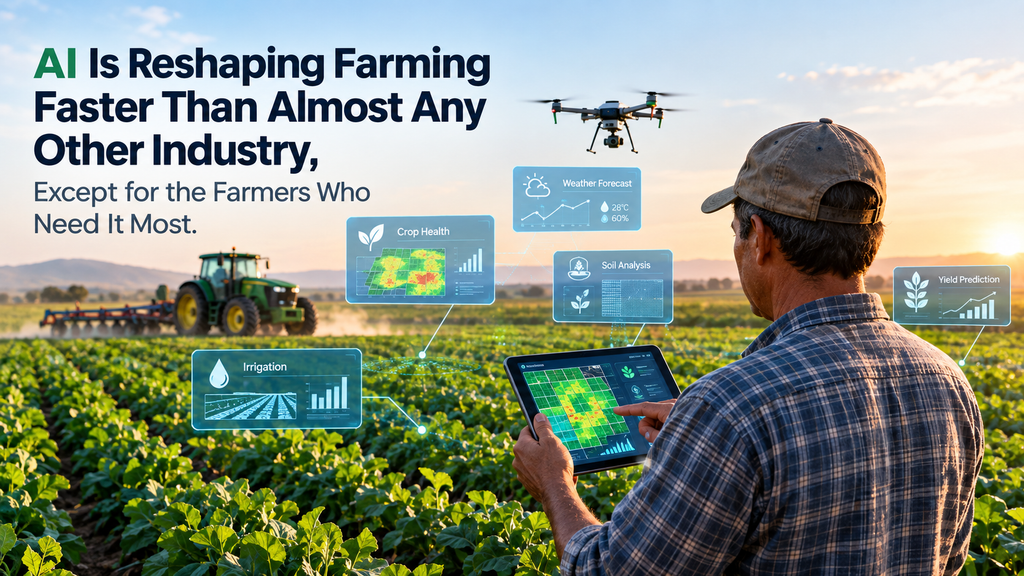
This year’s change, according to industry observers, is a movement from “digital agronomy”, AI that provides humans with greater information to act upon, to “autonomous agronomy,” in which physical systems sense, make decisions, and act in the field with little assistance from humans.
The use of automated machinery in agriculture is expected to increase by nearly 40% since 2020, and over 70 businesses are already developing the model, simulation, and data infrastructure that underpins autonomous farm equipment, a whole tooling layer that most people outside of the agtech industry are rarely aware of.
The results, where they’re being measured
The numbers are impressive for the farms that are really operating these technologies. In addition to actual cost savings on fertiliser and pesticides, adopters report yield increases of more than 15% on average from precision agriculture and satellite-guided input management. For well-executed AI deployment, broader industry estimates place the possible ROI as high as 150%, with resource efficiency gains, water, fertiliser, labor, consistently appearing throughout the studies monitoring this.
Marginal optimisation is not what this is. A 15%+ yield boost with lower input costs is the kind of figure that can change whether an operation is profitable in a bad year, not simply how lucrative it is in a good one, for a farm running on thin margins against volatile input costs and uncertain weather.
The distribution problem underneath the good news
This is where the tale becomes more intricate and significant than the ROI figures by themselves would indicate. Farm size has a significant impact on adoption. The vast majority of medium-sized farms are either already using or actively preparing to use AI solutions, and about 81% of large farms, those with more than 5,000 acres, are open to doing so.
However, even while nearly four out of five agribusinesses are aware of the potential benefits, only about one in five have completely embraced the AI tools they believe could help them. There is a significant difference between “we know this would help” and “we’re actually running it.”
Globally, the disparity is considerably more pronounced. Approximately 15 to 20 million smallholder farmers worldwide already use precision agricultural technologies, out of a total of about 500 million smallholders. That is a small, single-digit fraction of farmers that work the lowest margins and are least resilient to a bad season, making them perhaps the most in need of efficiency gains.
Precision agriculture, as it is currently implemented, is growing rather than narrowing the gap between huge industrial operations and smallholder farms, according to the honest framing of those who are actively researching this. The technology functions on its own. Expensive hardware, specialised integration, and region-specific calibration are all part of the distribution model that was developed for operations with the financial resources and technical personnel to cover those costs. The adoption figures demonstrate that it was not designed for a smallholder farm.
If you’re building or investing in this field, it’s important to understand a second layer of nuance: agricultural economists and publications like Inside Climate News have specifically pointed out that precision agriculture is sometimes used as a marketing frame to justify continued agricultural intensification. The environmental case for the technology is genuinely strong at the level of an individual field, but whether that adds up to a truly more sustainable food system depends on the policy
What’s coming next, and why it matters for smaller operations specifically
The most intriguing new category this year is what some are referring to as “agentic farming software,” which consists of AI systems that coordinate a farm’s entire operating schedule over the course of a week rather than just making recommendations. These systems are structurally similar to the AI agents that are emerging in software engineering, but they are applied to irrigation timing, spraying windows, and harvest scheduling collectively rather than as distinct tools.
On the agronomy side, a few early-stage companies are working specifically toward this, and it’s worth keeping an eye on because orchestration tools, if priced and packaged correctly, could potentially be less expensive to deploy at smaller scale than the hardware-heavy autonomous equipment that’s currently concentrated on large farms.
Additionally, there is a significant opportunity in mobile-first, less expensive solutions designed for smaller businesses and developing areas. These apps combine local soil and climatic data with AI suggestions for crop selection and risk, and they can be accessed on a phone instead of requiring specialised hardware. Compared to autonomous tractors, that distribution model is significantly different, and it is the most likely way to close the smallholder gap in the coming years.
What to actually take from this
Whether you’re building in this space or just tracking where AI is headed next, a few things worth knowing:
The “AI in agriculture” narrative is actually two distinct storylines with two distinct timelines: accessible AI tooling for smallholders, which is still in its early stages and largely unresolved, and large-scale autonomous agronomy for huge enterprises, which is mature and currently scaling. Don’t let the first story’s impressive headline ROI figures give the impression that the second story is farther along than it actually is.
Here, the open opportunity is in the distribution layer rather than the model layer. Crop identification, yield prediction, and resource optimisation are the fundamental AI skills that have been demonstrated. Packaging them for a farmer without the funds for specialised equipment or a technical staff to operate it is the real problem.
The smallholder gap should be viewed as a real market rather than a charity issue if you are an operator or investor assessing this industry. The 500 million smallholder farmers in the world are not a niche, and the development of the mobile-first, less expensive tooling category for them is still genuinely early. In the majority of the other categories in this newsletter, this is precisely the kind of gap that will lead to the formation of intriguing companies over the coming years.
Though it doesn’t receive the same attention as chatbots and coding agents, agriculture may be the most obvious real-world example of a larger trend worth keeping an eye on in all of AI: the technology typically comes first for those who can afford it, and the true long-term opportunity is almost always in closing the gap after that.
Please distribute this to anyone you know who is developing agtech or who is simply farming and wondering what can be used at their size. Next week, we’ll take a closer look at the mobile-first agronomy apps that are attempting to address the issue of smallholder distribution and determine which ones are genuinely gaining popularity.