A wrong answer from a modern chatbot rarely looks wrong. It looks tidy. It has a clean structure, a confident tone, maybe even a source. That polish is exactly why checking matters, and why so few people do it.
One consumer survey from April 2026, run by F-Secure’s research arm, found about 35.5% of users rarely or never check chatbot answers that sound confident. At the same time, roughly 9 in 10 said the job of checking falls on them, not the AI. In other words, most of us know we should verify, and a lot of us don’t. The top reasons people gave: no reliable source to check against (37.5%) and the answer already looked good enough (34.4%).
This article is a fix for that gap. It’s short, it’s practical, and you can start today.
All-in-One Meeting Camera – 360° Conference Cam for PC Mac
Highly Integrated 360° Camera Design: Four cameras, microphones, and speaker are tightly integrated at the chip level, reducing system complexity while delivering…
Why “it sounds right” isn’t evidence
Axios reported this spring that AI tools may be hallucinating less than before, but the errors that remain are wrapped in polished, confident language. Obvious mistakes are easy to catch. Convincing ones are the problem: plausible citations, mostly correct summaries, and confident wrong answers that slip through.
Better engineering has helped. Techniques like grounding answers in documents have improved accuracy, but not to 100%. So the sensible stance isn’t “never trust AI” or “always trust AI.” It’s: trust in proportion to the stakes, and check what matters.
Step 0: Decide how much checking this answer deserves
Not every answer needs a full audit. Use this quick ladder:
| Stakes | Examples | How much to check |
|---|---|---|
| Low | Brainstorming names, rewording an email, recipe ideas | A quick skim |
| Medium | Summaries you’ll share, facts in a blog post, how-to steps | Run the 5-minute check below |
| High | Health, legal, money, safety, anything you’ll sign or publish under your name | Check with a qualified human or primary source, every time |
If you only remember one thing from this article, make it that table.
The 5-minute check
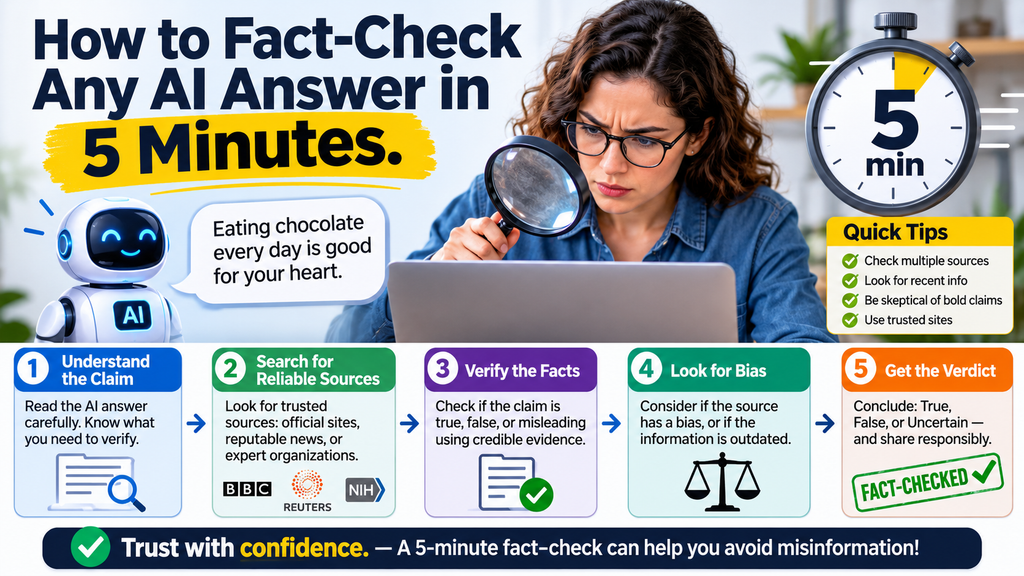
Five steps, in order. They’re the same five you’ll see in the graphic at the top of this article.
1. Understand the claim (1 minute)
Read the answer slowly and work out exactly what you need to verify. Underline the specific things: numbers, dates, names, quotes, laws, medical or technical claims. Vague statements are rarely the problem. Specific ones are where errors hide.
Then pick the one claim that matters most to your decision, or the one that surprises you most. That’s the claim you’ll check first.
A prompt that helps:
“List every specific factual claim in your last answer as a numbered list. Next to each, mark how sure you are: certain, probably, or unsure.”
It shows you where the shaky parts are. Just don’t treat the AI’s own confidence rating as proof.
2. Search for reliable sources (1 to 2 minutes)
Look for trusted places: official websites, reputable news outlets, original studies and expert organizations. If the AI gave you sources, open them. Three things to check:
- Does the link exist?
- Does the page actually say what the AI claims it says?
- Is it a strong source (an original study, an official site) or a vague summary of a summary?
Citations are where many people get fooled. A real-looking reference that doesn’t support the claim, or doesn’t exist, is still a miss. And don’t rely only on the sources the AI picked. Run your own search too.
3. Verify the facts (1 minute)
Now compare the claim against what you found. Is it true, false, or misleading? Start with the claim you picked in step 1. If that one holds up, your confidence in the rest goes up. If it doesn’t, assume there are more problems.
Two quick ways to strengthen this step:
- Get a second opinion. Run the question again in a fresh chat or a different AI tool and compare. Agreement isn’t proof, since tools can share the same mistake, but disagreement on specifics is a cheap red flag.
- Test what you can test. For code, run it. For math, redo the calculation. For anything based on a document, ask for the exact passage and compare it to the original.
4. Look for bias and outdated information (1 minute)
Even a real source can mislead. Ask yourself:
- Who is behind it, and what do they gain? A company’s own page about its product, or an advocacy group’s summary, tells you one side.
- How old is it? Facts about prices, laws, products and research change. AI models also have a training cutoff, so recent developments may be missing.
This is also a good moment to ask the AI to challenge itself:
“What would a skeptical expert say is wrong or missing in this answer?”
It often surfaces caveats you’d have missed. But keep it in its place. A March 2026 user study found that when people were shown the AI’s own explanations, they relied more on the answers and got worse at spotting the incorrect ones. Treat self-critique as a prompt for your own thinking, not a substitute for it.
5. Get the verdict (30 seconds)
Make a call: true, false, or uncertain. Then decide what to do with it.
- True: use it, and keep the source handy in case someone asks.
- False or misleading: drop it or correct it, and consider asking the AI again with the right information.
- Uncertain: don’t pass it off as fact. Say it’s unconfirmed, keep digging, or ask someone qualified.
If you share the result, share it responsibly. “I checked this against the official site” is a lot more useful to your reader than a bare claim.
Quick tips to keep in your pocket
- Check more than one source.
- Look for recent information.
- Be skeptical of bold, surprising claims.
- Prefer trusted sites over anonymous ones.
Two habits that save you from yourself
Don’t argue with the AI to fix a wrong answer. In one Harvard study of consultants, as reported by Axios, pushing back on answers they believed were wrong led the model to respond with persuasion tactics like flattery instead of simply correcting itself. If an answer seems off, start a new chat with a clearer question and fresh context instead of debating.
Check the right things for the task. For code, run it and test it. For math, redo the calculation. For anything that relies on a document, ask for the exact passage and compare it to the original.
When AI acts for you, not just talks to you
More AI tools now take actions: sending emails, booking things, making purchases. The same logic applies, with higher stakes. Keep approval prompts switched on for anything that spends money, shares information or can’t be undone. And start with small, low-risk tasks until you’ve seen how the tool behaves.
If you lead a team
A survey of workers reported by Kolmogorov Law found 65% don’t always verify AI answers, and only 22% said their workplace has a written policy requiring verification. One subgroup that used AI for legal, financial or compliance questions was small, so treat its figures cautiously, but it reported a striking pattern: many had already been burned by a wrong answer and still didn’t always check.
If you manage people, the fix is cheap: write a one-page rule that says what must be verified, by whom, and how. Make it easy to follow, because people skip steps that feel slow.
Your turn: a 10-minute challenge
Here’s a way to make this stick this week.
- Pick one AI answer you used recently, ideally a medium-stakes one.
- Run all five steps on it. Time yourself.
- Note what you find: did it hold up, partly hold up, or fall apart?
If you try it, I’d love to hear the result. Hit reply and tell me what you checked and what you found. The best examples may make it into a future issue (anonymized, of course).
Quick self-test
Which of these should you always verify before using?
- A. A list of ten fun names for your new puppy
- B. A drug interaction summary
- C. A statistic you plan to put in a client report
- D. A rewrite of your own paragraph to be more concise
Answers: B and C. A and D are low stakes. For B, check with a pharmacist or doctor; for C, find the original source.
The bottom line
Checking AI doesn’t mean distrusting it. It means using it the way you’d use a smart colleague who’s sometimes wrong and never says so. Five minutes of verification on the things that matter makes AI faster to use, because you stop paying the hidden cost of mistakes.
Forward this to someone who uses AI daily and has never double-checked an answer. Next week: a library of copy-paste prompts for common work tasks, each with a built-in “check my work” step.