
We discussed the uneasy divide in AI-driven agriculture last week: robust outcomes for large farms and a precision-agriculture toolkit that only reaches a small portion of the approximately 500 million smallholder farmers worldwide. The problem statement is less intriguing than the follow-up question because only a few products are truly closing that gap, and their methods are very different from the autonomous tractor, satellite dashboard version of “AI in agriculture” that receives the majority of funding headlines.
The pattern across the products that are actually working
Before giving names, it’s important to identify the pattern that appears in every example that is gaining significant traction: these tools function well on simple smartphones, operate offline or over erratic connections, speak a farmer’s native tongue, and provide a clear response to a single question rather than attempting to be a dashboard. From the standpoint of a product demo, none of that is exciting. It’s all the real unlock.
Plantix: the free diagnosis app millions of farmers already use
Plantix is arguably the best illustration of “boring, focused, and it worked.” The idea is almost aggressively straightforward: a farmer snaps a picture of a sick or failing plant, and the app recognises the issue and suggests a remedy. On crisp photos, accuracy is estimated to be above 90%. It answers the one issue that really costs a smallholder money: what’s wrong with this plant, and what do I do about it. It is free, compatible with any smartphone, and doesn’t require a farmer to comprehend NDVI maps or interpret a satellite dashboard.
The way Plantix has expanded its reach without requiring every farmer to download an app is perhaps more intriguing than the software itself. Plantix’s underlying diagnosis engine was integrated straight into WhatsApp and Telegram chatbots, which farmers currently use for everything else, by Digital Green, an initiative dedicated to democratising agricultural knowledge.
By avoiding literacy, language, and connectivity issues that a stand-alone software would still encounter, that integration alone has addressed over 5 million farmer enquiries in Kenya, Nigeria, Ethiopia, India, and Brazil. The lesson in that figure is that meeting farmers via a messaging app they already have open is frequently the most effective way to distribute smallholder AI.
Farmer.Chat: agricultural extension as a conversation, not a dashboard
farmer.Chat adopts a similar but different strategy: it is a generative AI chatbot that replaces the traditional role of a human agricultural extension agent by responding to open-ended, context-specific questions about soil, climate, and crop-specific decisions.
Because they rely on a small number of skilled human agents physically contacting farmers, frequently in isolated locations with inadequate infrastructure, traditional extension services have traditionally had difficulty growing. farmer.Chat’s wager is that a large portion of what those operators actually offered was information distribution, and that a well-designed AI system can provide similar, localised advise on demand, at practically infinite scale, across mobile apps and messaging platforms that farmers already have.
The model, not the current scale, is the more significant signal: a chatbot doesn’t require new hardware, new infrastructure, or a farmer to alter how they already communicate. The early deployment data is still modest in absolute terms, with tens of thousands of users and hundreds of thousands of queries across its initial country deployments. In contrast to the autonomous-equipment side of agtech, where each unit of scale necessitates another costly machine in a different field, it scales the way software scales, which has a fundamentally different growth trajectory.
AgroStar: proof the model works at real scale, not just pilot scale
If Farmer and Plantix.AgroStar demonstrates the model’s functionality on a scale that truly counts, whereas Chat demonstrates its functionality. According to reports, the platform provides AI-driven agricultural advice in 11 regional languages to over 10 million smallholder farmers in India.
Ten million is not an experimental program or a rounding error against the world’s smallholder population, but rather a significant demonstration that mobile-first, language-localized When AI advice is developed around the real limitations smallholders have rather than being scaled down from an enterprise solution, it can achieve genuine scalability.
The common theme throughout all three of these is that, to put it simply, the adoption of AI by smallholders was never truly hampered by the quality of the underlying AI. Current AI models perform well in disease diagnosis, conversational agriculture guidance, and localised advisory.
Distribution, cost, device specifications, connectivity presumptions, and language, was the obstacle, and the successful products were those that addressed distribution as the real product issue to be resolved rather than as an afterthought after the AI model was developed.
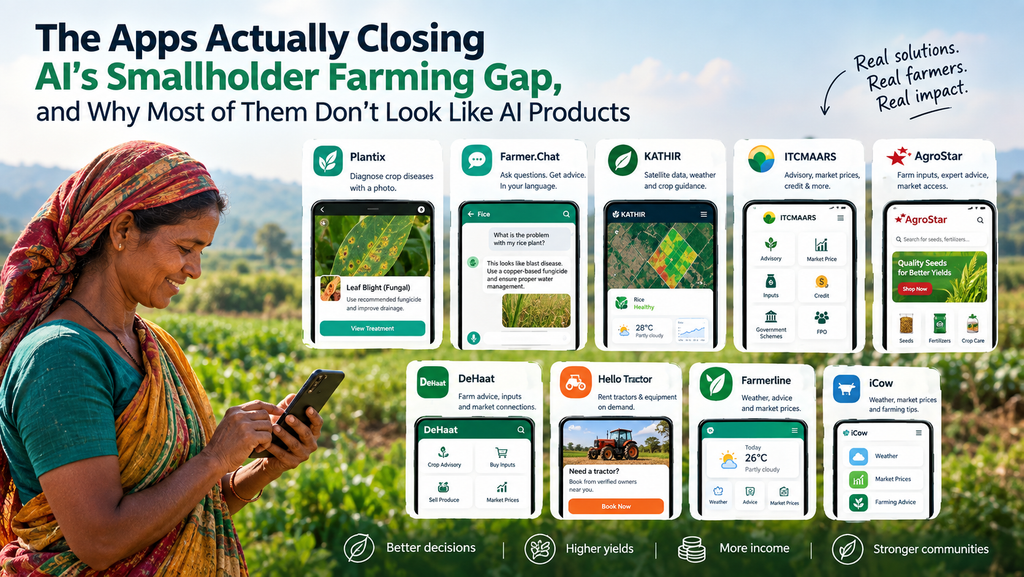
| App / Platform | What it does |
|---|---|
| Plantix | Farmers photograph a sick crop and get AI-powered disease/pest diagnosis and treatment guidance. |
| Farmer.Chat | Conversational agricultural advice through chat, voice messages and crop photos, including local-language support. |
| KATHIR | Kerala-focused digital agriculture platform using satellite imagery, remote sensing and AI for weather, sowing and crop-disease guidance. |
| ITCMAARS | Combines agricultural advisory with mandi prices, credit, inputs, government schemes and farmer-producer-organisation support. |
| AgroStar | Digital agricultural advisory and access to farm inputs, including seeds, fertilizers and crop-protection products. |
| DeHaat | Digital platform combining farm advice, inputs and connections to produce markets. |
| Hello Tractor | Connects farmers with tractor owners so smallholders can access mechanization without owning expensive machinery. |
| Farmerline | Provides farmers with agricultural advice, weather information and market prices through digital tools. |
| iCow | Mobile-based agricultural information including weather forecasts, market prices and farming advice. |
Why this matters beyond agriculture
This tendency is more widespread than it might initially appear if you’re constructing anything for an underserved or resource-constrained market, not only farming. Most AI firms have an innate tendency to focus on creating the most powerful version of the tool before considering accessibility.
Instead of building the full-featured version and hoping adoption follows, the products that actually reach underserved users at scale typically do the opposite: they begin with the real constraints of the user, the device they have, the connectivity they can rely on, the language they think in, the channel they already trust, and fit a genuinely useful but narrower AI capability inside those constraints.
For anyone developing AI products for a market where “just use the API and build a nice interface” subtly assumes a smartphone, trustworthy data, fluency in English, and ease downloading new apps, assumptions that don’t hold true for a significant portion of the global population, in agriculture or anywhere else.
What’s still missing
This does not imply that the smallholder gap has been closed. The full precision-agriculture toolkit available to large farms, which includes autonomous equipment, variable-rate input application, and integrated yield forecasting that these mobile-first tools don’t try to replicate, is more comprehensive than these tools, which are still focused on disease diagnosis and general advice.
A distinct, overlapping set of fintech-adjacent agricultural products is addressing the financing and market-access side of the smallholder problem, which includes obtaining fair prices, obtaining credit, and managing risk. The two categories haven’t yet completely merged into something that manages both agronomic advice and financial access in one location.
The truth is that this is genuine, significant progress on the most challenging aspect of the smallholder gap, knowledge access, using a strategy that is fundamentally different from how the large-farm side of agtech is being developed. It’s not yet a complete picture of what would be needed to close the gap.
What to actually take from this
The product brief is typically the constraint whether you’re working in this area or any other market with limited resources; it’s not a problem that can be solved after the fact. Every time this pattern has occurred, narrow-and-adopted outperforms broad-and-unreachable. Therefore, build for the real device, connection, and language first, and let the AI capacity be as limited as it has to be to fit.
The messaging-app-integration methodology that Digital Green employed with Plantix is worth closely examining as a distribution strategy in and of itself, independent of the underlying AI, whether you’re assessing this industry as an investor or operator. In every example that has truly reached meaningful scale, meeting people within a channel they already trust consistently outperforms the standalone-app strategy.
Send this along if you’re developing for a market where the request to “just download our app” seems excessive. Next week, we’ll return to the finance side to find out what agtech investors are genuinely looking for after 2025’s record year and whether smallholder-focused firms have received any of that money yet.