Every few months, someone claims that artificial intelligence (AI) has changed everything or, conversely, that it is overhyped and that no one really utilises it. The 2026 data presents a more intriguing and detailed narrative than any of those lazy framings, one that highlights the distinction between testing something and incorporating it into your life.
The headline growth is real
Within three years of ChatGPT’s introduction, generative AI reached about 53% of the population, a quicker adoption curve than either the internet or personal computers at the same time. This August, ChatGPT alone surpassed 1 billion weekly active users,
up from 400 million at the beginning of 2025. Over the past five years, the number of users for each tool has more than tripled. In terms of “did a new technology arrive,” AI arrived more quickly than anything equivalent in contemporary history.
But adoption and habit are two different numbers
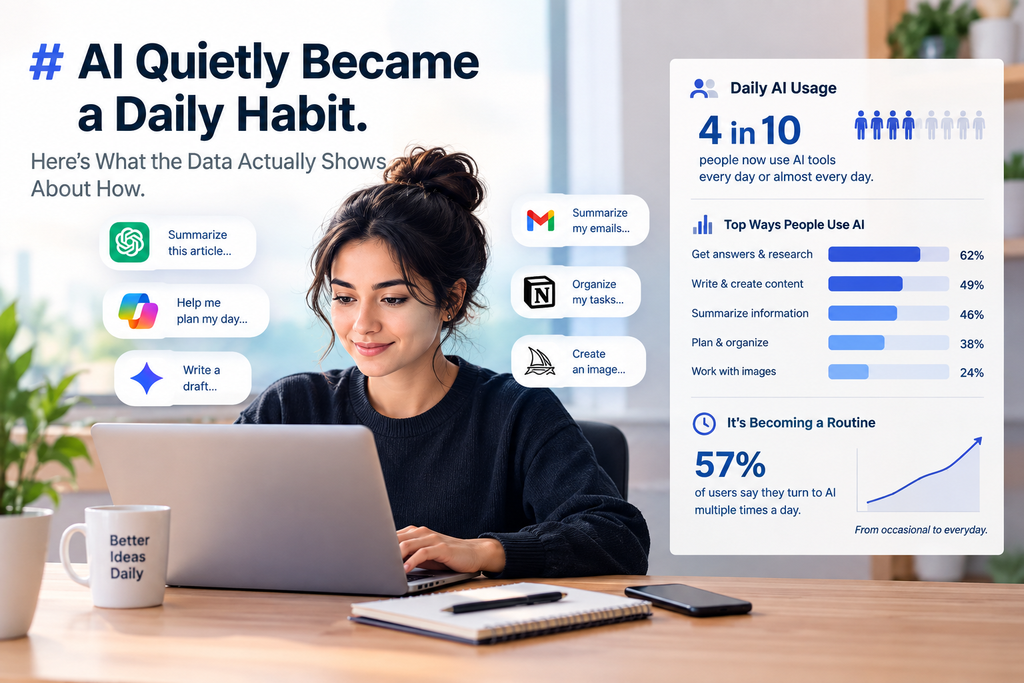
Approximately 61% of US individuals have used AI in the last six months, but everyday usage worldwide is closer to one in five. This is the disparity that most media misses. It’s the entire story in one comparison, so read that again.
Most folks have given it a try. A significantly smaller group has incorporated it into their daily regimen. Instead of being a daily requirement like a phone or search engine, AI now serves the majority of people as an occasional resource, something you reach for on a specific task.
That margin is closing, not staying the same. The percentage of US citizens who use it for personal purposes on a daily basis has increased from approximately 22% in early 2024 to about 31% now. Among the heaviest users, Gen Z in particular, adoption is about 76%, which is significantly higher than the roughly 20% among boomers.
Even within Gen Z, however, opinions aren’t all that positive: about one-third say they don’t think AI is very useful in their daily lives, which is more than twice as sceptical as the general public, and the majority say they have serious concerns about employing it at all.
Where it’s actually showing up
The real-world applications of AI are more commonplace than the headlines imply, and that’s not a complaint; rather, it’s an indication that a technology is being utilised rather than only admired. The vast majority of frequent users claim personal use as the most common category, surpassing both professional and business use cases.
AI assistants are being asked what to make for supper, what to buy, and how to organise a weekend. A third of customers now report using an AI tool instead of a traditional search engine to begin their information searches, which is a truly major change in a behaviour that has been consistent for 20 years.
Contrary to what the personal-use figures indicate, the image at work is more modest. The majority of workers say they use AI little or not at all on the job, while approximately one in five US workers report using it in their actual jobs, up from about one in six a year earlier. This is a significant increase, but it is still a minority. If you’re developing a product for either group, it’s helpful to realise that the professional AI story is earlier-stage than the personal-life AI story.
The trust gap nobody solved yet
If you’re developing something that interacts with AI, this is the aspect of the statistics that should be most important: utilisation is increasing, but comfort isn’t. About 50% of Americans say they are more worried than excited about AI’s expanding role in daily life, which is a significant increase from a few years ago.
Only approximately 10% say they are more excited than worried. Additionally, the majority of individuals claim that they have little to no choice over how AI appears in their lives and that they would like to see more of it. However, a sizable majority of respondents to the same studies said they would still accept AI help with routine jobs if it were provided effectively.
Genuine worry, a lack of control, and a genuine openness to targeted, well-designed assistance are not mutually exclusive. It’s a rather accurate description of what people really want: not less AI, but AI that is readable, optional, and well-defined, as opposed to AI that unexpectedly appears inside something they weren’t prepared for.
What this means if you’re building anything AI-facing
A few practical implications worth sitting with, whether you’re building a consumer product or just thinking about how your own team uses these tools:
People have tried it- is not the same as “people have adopted it,” and confusing the two results in poor product choices. If your product is designed for people who are accustomed to using AI interfaces on a daily basis, you could only be targeting a fifth of your target market.
The worrying data is not an excuse to conceal the AI; rather, it is a design brief. The readiness to accept AI assistance with everyday chores is still high; people are not generally rejecting AI. AI that seems opaque or involuntary is what they are rejecting. These days, clear disclosure, an evident opt-out, and a visible border around what the AI touches and doesn’t touch are more than simply compliance checkboxes; they’re actually bridging the gap between “concerned” and “willing to use it.”
The generational narrative is true, but most reports exaggerate it. Indeed, younger users adopt more quickly. However, a sizable portion of the most technically proficient and online-savvy population is actively sceptical, frequently for reasons unrelated to the tool’s functionality, such as environmental cost and lack of control, which frequently come up as explicit, stated concerns rather than general uneasiness. Assuming universal excitement when marketing to a younger demographic is not as solid as it would seem.
The honest summary
AI arrived quickly. For the majority of individuals, it is still only partially and cautiously incorporated into daily routines; this caution is specific and articulable rather than merely inertia. It’s neither “AI is everywhere now” nor “AI is all hype.” Instead, it’s a more beneficial and healthful approach to interpret the situation. The majority of individuals have experimented with this technology, a small percentage have incorporated it into their daily lives, and the majority are still debating how much of their lives they truly want it to impact.
Send this to someone who is certain that everyone else has already fully embraced AI if it changed your perspective on how you use it yourself or your product. Next week: a few successful instances of “AI you can trust” in product design.