

As of last summer, about 90% of professional developers surveyed worldwide were using AI coding agents at work at least weekly, and more than two-thirds were using one everyday. last is the clear indication that AI coding agents have transitioned from novelty to the standard. That is no longer early-adopter territory. Software is written that way by default.
What’s going on in its periphery and what it’s subtly beginning to break inside engineering teams that haven’t adapted to it are more intriguing than the adoption figure.
From autocomplete to actual delegation
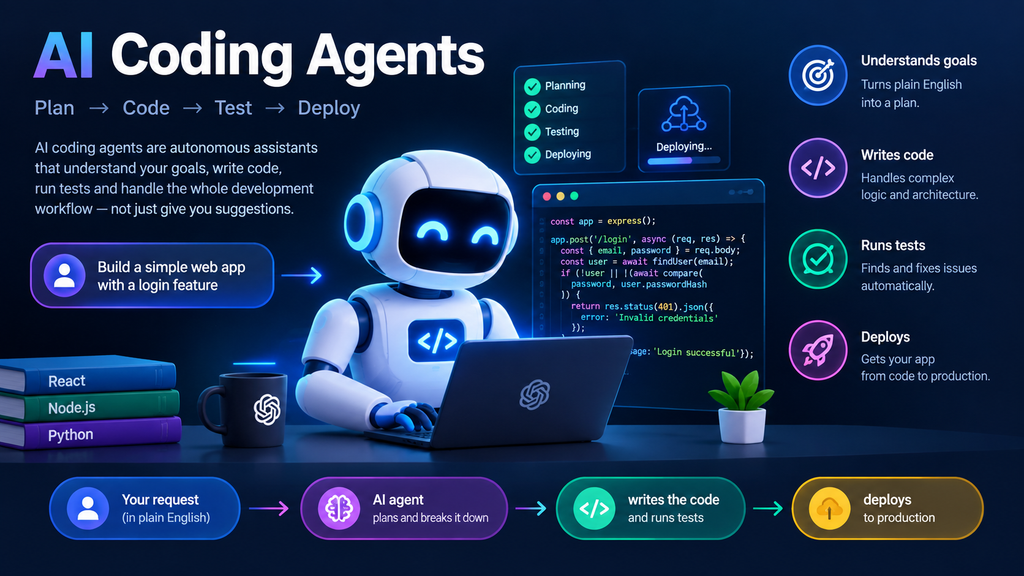
“AI writes code now” is an understatement, therefore it’s important to be specific about what changed. The tools completed a line a few years ago. After that, they completed a function. An agent can now pick up a ticket, study the pertinent portions of the source independently, create the implementation, run tests against it, correct its own errors, and open a pull request at an increasing number of companies, all without a person touching a keyboard. That isn’t on the roadmap. It is currently being used in production at actual businesses.
The underlying change is what developers of these tools refer to as long-running autonomous workflows: agents now function in execution loops, actively exploring a codebase like a novice engineer would rather than pulling from a static index, as opposed to responding to a single prompt and stopping.
In contrast to the back-and-forth chat interface that most people still image when they hear the term “AI coding tool,” some platforms operate these loops in background environments for extended periods of time.
The bottleneck moved, it didn’t disappear
This is the element that should genuinely alter your perspective on your engineering organization, not just the tool you purchase. The head of a significant coding-agent product succinctly summed up what he’s hearing from engineering leaders: an individual can use an agent to produce ten times their typical production, but the rest of the company hasn’t caught up to absorb it.
Pull request review capacity is one specific area where such gap appears. quicker code production only shifts the strain downstream from “how fast can we write this” to “how fast can we safely confirm this is correct.”
It does not result in quicker software being deployed without a corresponding increase in review and verification capability. Without addressing the review bottleneck, a team that resolves the writing barrier hasn’t really accelerated. The location of the slowness has simply been moved.
That caution is not merely theoretical; it is supported by evidence. Large, real velocity gains were found in a recent longitudinal study of AI coding agents in real repositories, but only in projects that were new to AI tooling.
This was accompanied by a consistent, less talked-about cost: static-analysis warnings and code complexity increased significantly in repositories that adopted agents, even though the initial speed advantage gradually diminished. According to the study, messier and faster are not mutually exclusive, and the latter appears more consistently than the former.
A useful way to think about where your team actually is
There are currently four levels of AI adoption within an organization, ranging from completely restricted access to entirely AI-native processes, according to a framework that engineering leaders are discussing.
The diagnostic question that lies beneath a framework like this is what makes it valuable, not the labels themselves: is your team’s real AI adoption stage in line with your review and quality infrastructure, or has the writing side outpaced the checking side?
Nowadays, the majority of teams are able to provide an honest response to that question with some thought, and the majority dislike the honest response. That’s okay; there is a gap that can be filled, not a crisis. However, before you make more investments to speed up code creation particularly, it’s important to understand which side of the divide you truly stand on.
The other real shift: nobody’s just picking one model anymore
The most successful configurations this year aren’t centred around a single vendor’s coding agent, which is a second trend to be aware of while selecting tools for your team. They are based on allocating distinct models to various aspects of the workflow: a more powerful, costly model for task planning and architecture, and quicker, less expensive models for carrying out the ensuing subtasks concurrently.
A new product launch isn’t the discovery that has generated the most conversation in this field lately. The reason for this is that integrating different suppliers into a single process routinely outperforms the all-in-one stack offered by a single vendor.
This approach to tool selection differs significantly from “which coding agent is best.” Once more, the more pertinent question is task-specific: which model executes quickly and cheaply, which model plans well, and how do you connect them such that the costly reasoning only occurs where it is truly required?
What to actually do with this
If you are in charge of an engineering team, there are three things you should do now instead of waiting to see the review backlog:
- Prior to auditing your code generation speed, check your PR review capacity. You haven’t overcome your bottleneck; rather, you’ve moved it if your team is measurably faster at producing code but not at properly deploying it.
- Rather of allowing AI adoption to occur unevenly among individual engineers who have each reached their own comfort level, clearly determine what stage of AI adoption you are actually functioning at. The “one person 10x’ing, nobody else keeping up” pattern is actually caused by uneven adoption within a single team.
- Quit viewing this as a decision involving only one vendor. Determine whether your most valuable engineering time is being used for execution and boilerplate work or planning and architectural work, and think about whether using a mixed-model arrangement is preferable to using a single tool for everything.
Everyone is already aware that “AI writes code now” is not the story here. According to the narrative, the companies who are succeeding are handling this as an operating-model issue rather than a tools issue. The equipment is already adequate. The real work left to accomplish is for the rest of the organization to catch up to them.
Send this to the person in charge of your engineering process if one of your team’s engineers is using AI while the others are stuck reviewing their work. Next week: the three tests that identify agent-introduced complexity before it ships, as well as what a truly AI-native code review process looks like.