

For twenty years, ranking on Google was the only way to get found online. That remains the primary game. However, a second one is emerging alongside it, so it’s important to be aware of it if you publish anything online.
Adam Fry, OpenAI’s ChatGPT consumer lead, stated in an interview published by Big Technology on November 3 that ChatGPT’s volume of search-style queries is currently about one-fifth of Google’s. In just two months, he added, ChatGPT’s weekly user base increased from 1 billion to 1.2 billion. That’s rapid growth because ChatGPT only started gathering live web results roughly 18 months ago.
Before we continue, let me warn you. This is a claim made by OpenAI. The Verge pointed out that OpenAI counts “search-like” requests in its own manner and that Fry failed to identify the source for the Google comparison. It makes no mention of the volume of traffic AI tools send to websites or the types of queries that are won. Instead of using it as a scoreboard, use it as a clear indication that behaviours are shifting.

Ray-Ban Meta (Gen 2) Wayfarer, Negro Mate, Lentes Transparentes
Haz más y mantente conectado sin tener que coger tu teléfono con gafas de IA impulsadas por Meta AI. Captura grabaciones de vídeo, traduce…
Why this matters even if you never use ChatGPT
An AI does not display ten links when someone asks it “what’s the best way to do X?” It provides a response, occasionally citing several sources. The modern equivalent of being on page one is being one of those sources.
Although they are primarily from SEO firms, some preliminary figures suggest the stakes, so use them as guidance:
- A Conductor analysis of 21.9 million queries found Google’s AI Overviews showed up on about 25% of searches in March 2026, nearly double the year before.
- Seer, an SEO agency, reported in April that brands cited inside an AI Overview earned 120% more organic clicks per impression than when they weren’t cited. But on informational queries, clicks were still 38% lower than on searches with no AI Overview at all.
- One ad-tech company, Taboola, blamed AI summaries when its revenue fell 6.9% this quarter.
The pattern: fewer clicks overall, but a bigger reward for being the source the AI trusts.
One thing to know before you start
“AI search” is not a single concept. ChatGPT and Google’s AI Overviews returned the same list of brands fewer than 1% of the time, according to SparkToro’s study, which ran the same 12 prompts through ChatGPT thousands of times. Don’t expect one adjustment to work everywhere because different engines draw from different sources.
Additionally, a high Google ranking does not ensure a ChatGPT citation, and vice versa.
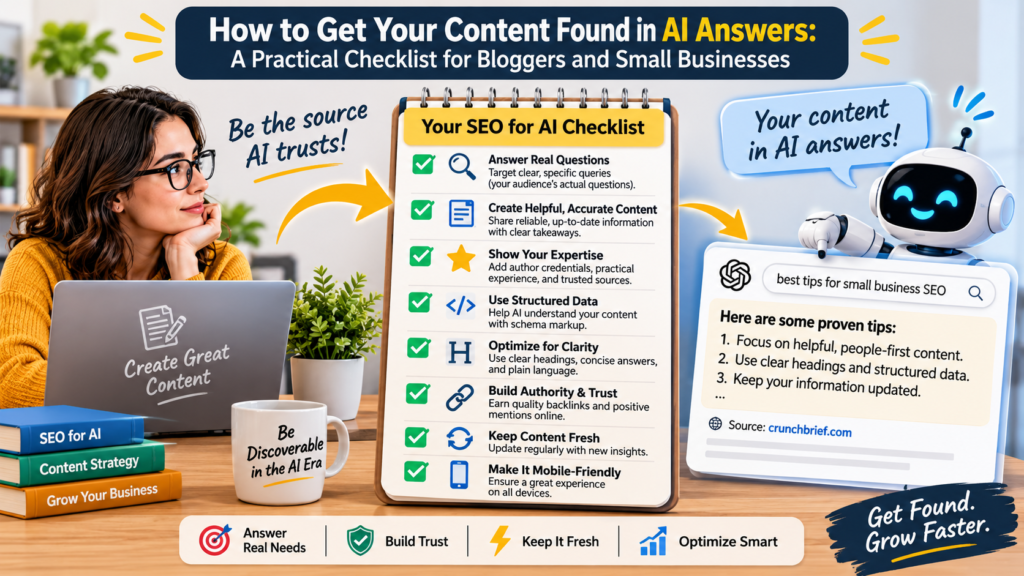
The 8-step checklist
The field is often called generative engine optimization, or GEO. Most of what follows is familiar good SEO with a few twists. Much of the advice comes from SEO vendors, so I’ve stuck to points that several independent sources agree on.
1. Write answer-first. Turn your headings into the questions people actually ask, then answer in the first one or two sentences before adding detail. AI tools tend to lift clear, self-contained passages. A buried answer is easy to skip.
2. Be specific, and show your sources. Replace “a recent study found” with “the March 2026 Conductor analysis of 21.9 million queries found.” Names, dates and numbers give a model something solid to cite. The 2024 Princeton and IIT Delhi paper that coined the term GEO found that adding sources, quotations and statistics helped visibility, while keyword stuffing didn’t.
3. Make it obvious who you are. Add an author name with a short bio, an About page, and consistent branding across your site and social profiles. Trust signals matter for people and machines alike.
4. Don’t block the crawlers you want. Check your robots.txt file. Some AI companies use separate crawlers for search and for training, so you can allow one and block the other. Read each company’s current documentation rather than copying a list from a blog post. Also make sure your key content is plain text on the page, not hidden behind scripts or pop-ups.
5. Build mentions off your own site. A study by SE Ranking of 129,000 domains and over 216,000 pages found that brand mentions on community sites like Quora and Reddit were linked to ChatGPT citations. Genuine participation helps: answer questions, publish useful guest posts, get reviewed, get quoted. Don’t spam.
6. Keep pages fresh and say so. Update important articles regularly and show a visible “last updated” date. Old numbers are one of the easiest ways to lose trust.
7. Skip the tricks. Keyword stuffing doesn’t help. Mass-producing thin AI-written pages is risky, and Google has a policy against scaled content abuse. And in SE Ranking’s study, the much-hyped llms.txt file showed no effect on citations. Time spent on better pages beats time spent on gimmicks.
8. Measure, don’t guess. Which brings us to the audit.
Zoom PodTrak P4next Podcast Recorder with 4 Inputs + AI Noise Reduction
Four XLR inputs with multitrack recording support up to four people plus a call-in guest, giving you flexibility for in-person and remote…
The 10-minute audit
Do this once a month. It’s free and tells you more than any generic advice.
- Write down 10 questions your ideal reader might ask about your topic.
- Ask each one in ChatGPT, Google (look for an AI Overview or AI Mode), and Perplexity.
- Record in a simple table whether you’re cited, who is, and what the cited pages do well.
| Question | ChatGPT | Google AI | Perplexity | Who got cited |
|---|---|---|---|---|
| (your question) | yes / no | yes / no | yes / no | (names) |
- Pick the question where a competitor beats you and compare their page with yours. Is it clearer? More specific? Better sourced?
- Check your analytics for traffic from AI tools, and note any growth.
Results vary from run to run, so don’t panic over one miss. Look for patterns across the month.
What to expect
Be realistic. GEO is young, the research is thin, and the engines change often. Nobody has a guaranteed formula, and anyone selling one is overselling. But the habits above are cheap, they improve your content for human readers too, and they don’t depend on any single platform.
Your turn
This week, run the 10-minute audit on one topic you care about. If you’d like to share what you find, hit reply and tell me which question surprised you most. A few reader results may appear in a future issue, with names removed.
Know a blogger or small-business owner who’s noticed their traffic changing? Forward this their way. Next week: how to tell whether AI is actually sending you readers, using free analytics settings.