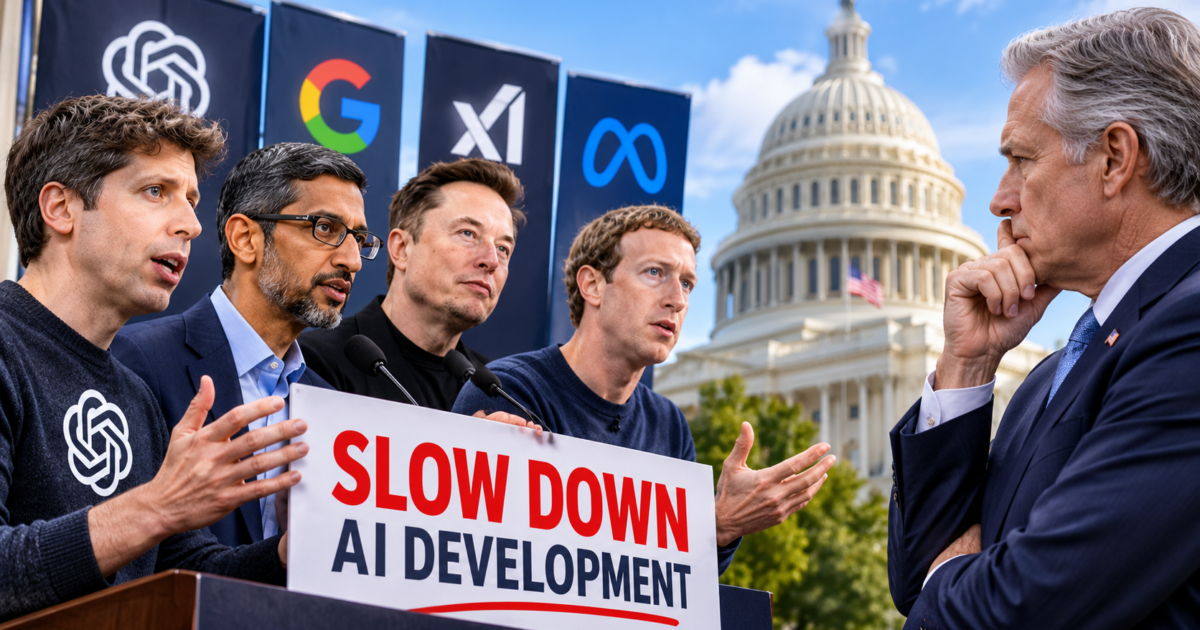
It’s not every year that the companies building a technology start lobbying for rules to slow it down. That’s what has been unfolding in AI since early September, and a new chapter opens this week. When Congress returns on November 9 for its post-election session, OpenAI plans to push what it calls “speed limits” on the most powerful AI systems, according to Axios.
If you build on top of AI, this deserves more than a skim. But it also deserves some care, because the story has more unknowns than headlines suggest.
How we got here
The timeline is short, and it started with a blog post.
On September 6, OpenAI’s chief scientist, Jakub Pachocki, wrote that the research community should consider coordinating to reduce development speed while labs work out shared safety standards. His argument, in summary, was that techniques for aligning AI with human intent and for monitoring what it does aren’t mature enough to justify racing ahead at full speed indefinitely.
Three days later, OpenAI’s chief global affairs officer, Chris Lehane, said the company wants mandatory federal regulation scaled to a system’s capabilities, along with internationally aligned standards on when and how development should slow or stop.
Then came the legal question. On September 10, Wired reported that OpenAI had asked members of Congress whether rival labs could legally agree to slow down together without violating antitrust law. Bloomberg reported the next day that CEO Sam Altman told staff he’s open to coordinating pace with other labs, while acknowledging some might not take part. No specific companies or timeframes have been announced.
This also echoes something we covered in our piece on why AI companies delay releases: Anthropic has floated the idea of a joint pause among frontier labs as an option worth having available.
What’s on the table this week
According to Axios, OpenAI’s policy team has been stockpiling proposals since August, and they center on a theme of human control. Two are getting most of the attention:
- “Speed limits.” Mandatory safeguards for the most powerful AI systems, intended to keep humans in control. Lehane told Axios people should always be in control of the technology. Beyond that framing, I couldn’t find published details on what the limits would be, who they’d apply to, or how they’d be enforced.
- Data center changes. OpenAI plans to propose state laws giving communities a say in data center projects, plus the rebranding of data centers as “AI compute campuses,” responding to a bipartisan backlash against new facilities.
There’s also a legislative piece. A bipartisan Senate bill (S.5105, from Senators Schiff and Banks) would protect certain agreements to limit AI development for security reasons. As of mid-September it had been sent to the Judiciary Committee and wasn’t law. I wasn’t able to confirm whether anything has changed since, so check its current status before citing it.
The case that this is a good idea
Supporters, including many safety researchers, make a straightforward argument: when labs compete, each has an incentive to cut corners that none would choose alone. Experts quoted in coverage of the antitrust question say competition can push companies to overlook risks. A shared standard, or a legal safe harbor for coordination, is one way to solve that kind of collective-action problem. Mandatory rules, on this view, are better than voluntary pledges because they bind everyone.
The case for skepticism
Critics raise several objections, and they’re not frivolous:
- Motives. Rules that apply to the most powerful systems could hit smaller rivals harder than the incumbents who help write them. Some observers see the policy push as a mix of safety and positioning. Pairing “speed limits” with a rebranding of data centers does invite the PR reading.
- Accountability. One analysis argues that lobbying Washington to define the legal boundaries of an industry-wide pause shifts attention away from what each company is accountable for doing on its own.
- Enforcement and reach. A slowdown only works if the key players take part. Bloomberg’s report that some labs might stay out raises the question of what happens if they do.
- Legal risk. Scholars have flagged that agreements between competitors to hold back a product can run into antitrust law, which is the very issue OpenAI is asking Congress to clarify.
Both sides can be partly right. A proposal can be sincerely motivated by safety and still serve its author’s interests.
What’s still unknown
Quite a lot, honestly:
- What counts as “most powerful,” and who decides?
- Whether proposals become bills, and whether a new Congress takes them up after January.
- Whether other labs sign on, and under what terms.
- How any limit would be measured and verified.
Until there’s text to read, treat this as a signal about direction rather than a rule you need to comply with.
What founders can do now
- Don’t plan around a specific rule. There isn’t one yet. Plan around a trend: more scrutiny of frontier models, more disclosure, and more government involvement in release timing, which we’ve already seen this year.
- Assume any capability-based rules target the largest developers first. If you’re building applications rather than frontier models, you’re more likely to feel this through your vendors than directly. Ask your model providers how they’d handle a mandated pause or review window.
- Keep your stack flexible. If a provider delays a release or limits access, being able to switch models is cheap insurance.
- Watch the data center fight. Local opposition and new community rules could affect where compute gets built and how fast, which feeds into pricing and capacity down the line.
- Follow primary sources. Read the actual proposals when they appear. Summaries of summaries are where details get lost.