
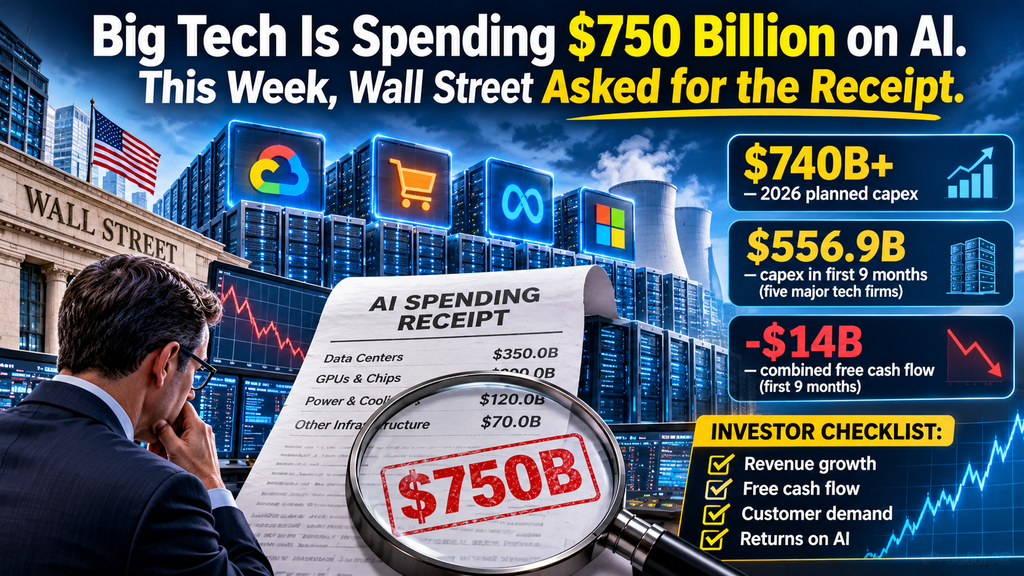
When four companies plan to spend about $750 billion in a single year, the number stops meaning anything unless you compare it to something. Bloomberg Businessweek did that earlier in October, putting Meta, Amazon, Microsoft and Alphabet near $750 billion of capital spending for 2026, much of it on AI data centers. S&P Global Market Intelligence’s consensus view is similar: hyperscaler capex roughly doubling this year to about $763 billion, then climbing toward $1.3 trillion in 2027.
That’s an enormous bet. This past week’s earnings were the first time markets seemed to push back on it in a visible way.
What happened this week
Alphabet reported on October 28, and its free cash flow turned negative for the second quarter in a row. The stock fell roughly 11 to 12% afterward, depending on the report you read. The reasoning was simple: the company is spending on AI infrastructure faster than the business generates cash, and investors wanted to see the payoff before accepting more of it.
Other reactions were mixed, and the sources don’t fully agree on every move, so I’ll keep this general. One analysis argued that capex plans explained the stock split between the big names better than the usual earnings and revenue beats did. In plain terms, investors weren’t only asking whether AI spending is growing. They were asking whether the spending comes with a believable path to getting the money back.
That’s a real shift from earlier this year. In April, the same group of companies reported strong results and raised their capex guidance, and the mood leaned toward relief that AI demand was real. Now the mood has a second question attached.
Why the debate is harder than either side admits
There are two camps, and each is partly right.
The optimists point to demand. Cloud growth has been strong, executives keep saying they can’t build capacity fast enough, and AI features are lifting products like search. If customers want the capacity, building ahead of demand is rational.
The skeptics point to cash. Spending is projected to grow faster than revenue in the near term, which pressures margins. When free cash flow goes negative, something has to give: buybacks, dividends, borrowing, or the pace of the buildout.
Both can be true at once. A company can be right about long-term demand and still be punished for overpaying to meet it. Railroads and fiber networks both followed that pattern in earlier booms.

Plaud Note Pro AI Voice Recorder Transcribe & Summarize for Meetings Calls
Every conversation is covered, in person, on calls, and online. 4 MEMS + 1 VPU microphones with AI beamforming capture every voice…
Why startups should care
This isn’t just a Wall Street story. The money these companies spend is the foundation under most AI products you can buy or build on. Three effects are worth watching.
Compute prices and availability. Heavy capex is partly why GPU capacity became easier to rent over the past year. If investors force spending to slow, the pace of new capacity could slow too, and the era of generous cloud credits and cheap inference could tighten. I wouldn’t bet on it happening fast, but it belongs in your risk list.
Platform bundling. Companies under pressure to show returns will push harder to sell their AI products to existing customers. Expect more AI features bundled into plans you already pay for, and more pressure on startups selling point tools that overlap.
The funding mood. The public AI-lab offering expected this month, covered in our last piece, will be read against these same worries. If investors turn skittish about spending, it affects the valuation of every AI company, down to your own next round.
What I’d do in your position
- Price your dependency. For each major cloud or model provider you rely on, ask what happens to your margins if prices rise 20%, and what happens if credits end. Write down the answer.
- Avoid single-vendor lock-in where it’s cheap to avoid. Our earlier pieces on choosing models by task apply here. Being able to switch is a form of insurance.
- Sell on outcomes, not novelty. Customers are being asked the same question the market is: what did this spending actually earn? A startup that can show measured savings or revenue is better placed than one that shows a demo.
- Watch the next few earnings calls. Pay less attention to the headline capex figure and more to what executives say about returns, capacity constraints and timing.

All-in-One Meeting Camera – 360° Conference Cam for PC Mac
Highly Integrated 360° Camera Design: Four cameras, microphones, and speaker are tightly integrated at the chip level, reducing system complexity while delivering…
A fair caveat
The capex totals are approximate. The four outlooks measure capital spending differently, with finance leases and accounting changes muddying comparisons, so any combined figure is a rounded estimate and not a number a company confirmed. And one week of earnings doesn’t settle a multi-year argument. Markets can swing back the other way when the next quarter’s cloud numbers land.
The useful takeaway isn’t “the AI bubble is popping” or “the skeptics are wrong.” It’s that the question has changed from “will they build it?” to “can they afford what they’ve built?” Founders who plan for both answers will be in better shape than those who bet on only one.
If someone on your team keeps assuming cloud credits and cheap compute are permanent, forward this. Next week: a simple template for stress-testing your AI costs against a 20% price change.