

We haven’t mentioned “AGI” in six issues, and it wasn’t an oversight, it’s actually the most difficult phrase to write about in this entire field. Every few weeks, a new headline claims that it’s about to happen, that it’s a fiction, or that it has already quietly occurred. You’re reading it correctly if you found that puzzling rather than instructive. You’re not missing anything if you’re confused. It’s the debate’s current situation.
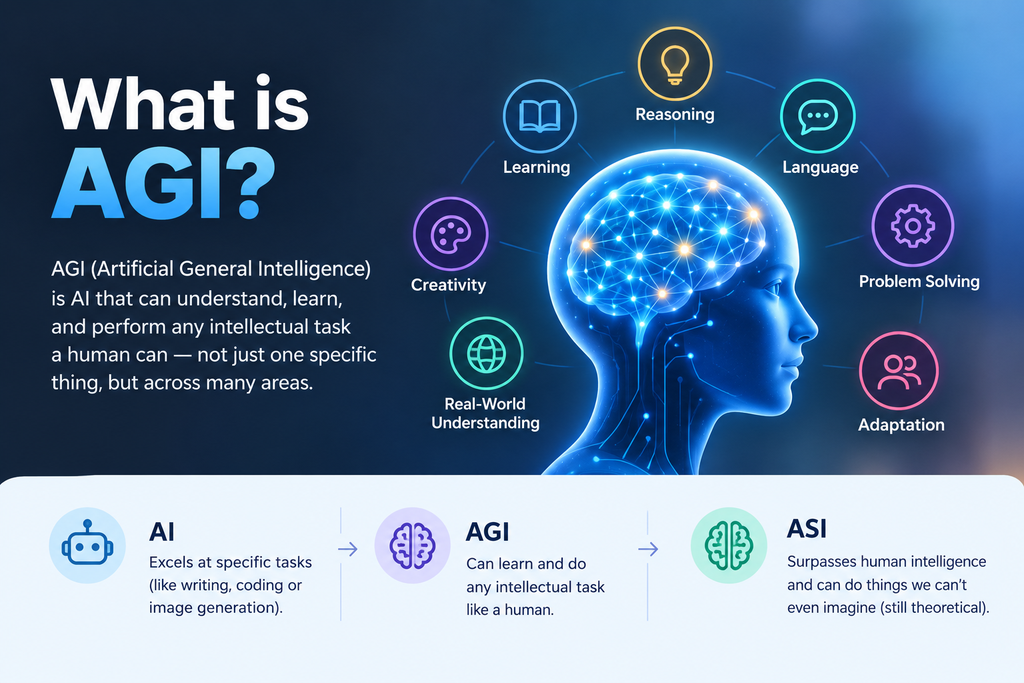
The predictions, laid side by side
The CEO of one frontier lab has predicted that AI systems will be “broadly better than all humans at almost all things” over the next year or two. This is an example of what is now available from people who are, by any standard, incredibly knowledgeable. The CEO of another well-known lab has been the industry’s most visible short-term optimist. Five to ten years from now, a prominent scientist at a different major lab splits the gap.
Furthermore, some of the most well-known sceptics in the field contend that existing architectures, regardless of how much they are scaled up, are fundamentally incapable of achieving this goal at all because they lack elements like robust world models and true causal reasoning, which cannot be fixed with more training data.
In just the previous few years, aggregated expert projections have changed significantly. According to one tracking effort, the median expected date was shortened by almost 27 years in just six years. The early 2030s are currently the focus of independent forecasting communities. According to several well-known commentators, “basically here already.” Some argue “not with this approach, maybe not ever.”
That disagreement is not limited. That is, individuals who attend the same conferences and read the same papers wind up on radically distinct timelines, sometimes more than 70 years apart.
The reason isn’t that anyone’s lying
Here, the most helpful reframe isn’t “who’s right.” Because there isn’t a single, accepted definition of AGI, different persons who confidently respond to “how close are we” are really responding to different queries.
A popular definition focuses on economic value and autonomy: a highly competent system that can outperform people in the most economically valuable tasks. By that standard, several of the present frontier models’ accomplishments, such as passing professional tests and exceeding the majority of humans on numerous cognitive benchmarks, appear to be significant advancements toward the objective, if not near it.
A different definition, which is more prevalent among academics who study the internal workings of these systems, focuses on grounded, causal understanding of the physical world. This is the kind of reasoning that toddlers execute with ease and that even the most sophisticated language models today still find difficult.
Frontier models have scored less than 1% on the most difficult exams created especially to examine this type of general reasoning, whereas humans score nearly 100%. The gap isn’t closing by that bar, and it might not even be the same type of gap that scaling closes.
Therefore, when two knowledgeable individuals differ by decades, it’s usually not because they disagree on the evidence. They can’t agree on which of these definitions, or a dozen more in between, is truly worthy of the term artificial general intelligence. It might not matter which definition proves to be philosophically true, which is a truly unsettling idea worth considering.
Regardless of whether a philosophy would refer to that as “real” understanding, economic and social disruption occurs if today’s systems are able to function as though they have a working model of the world well enough to create dependable, useful output.
The incentive problem nobody fully escapes
Another layer that explains a true trend in who forecasts what is worth naming clearly. Public timescales are consistently the shortest for those in charge of frontier AI labs. That is a structural fact about their stance; it is neither a coincidence nor necessarily dishonesty.
Lab leaders use AGI narratives to attract great researchers, raise funds, and maintain a competitive edge over rivals. Their estimates should be interpreted as calibrated forecasts after strategic communication. They are not inherently incorrect because of this. It does imply that they are not objective data points, and a lot of coverage continues to make the error of interpreting a lab CEO’s schedule as equal to an independent forecaster’s meticulously calibrated prediction.
It’s also important to keep in mind that no significant public figure’s confident one-to three-year AGI prediction has yet to materialise, and some have been subtly postponed without much notice after the initial date has passed. That doesn’t mean it won’t happen. It’s a good idea to view any particular near-term date as a tactic or a statement of hope rather than a timetable that you should stick to.
What to actually do with all this uncertainty
Making wise judgements today doesn’t require settling the AGI controversy. A few useful lessons learned:
Asking “when is AGI” should be replaced with “what specifically changed this week.” A documented failure mode, a new capability, and a benchmark score are all verifiable. “AGI is close” is not a claim that can be directly verified or addressed.
When you read a prediction, find out who made it and what they stand to gain from the timetable. The public remarks of a lab CEO, an independent forecaster, and an academic sceptic are all influenced by various motives, none of which are neutral.
Construct for current capabilities rather than potential ones. Underestimating AI isn’t the most costly mistake in this field; rather, it’s creating a roadmap that anticipates a sharp increase in capacity on a particular date and then having nothing to fall back on when that date goes silently, as the majority of them have done thus far.
Since the disagreement is ingrained in the definition and won’t be resolved by the next model release, the AGI debate will remain heated and unsolved for some time to come. The difference between following this story effectively and simply riding the hype cycle up and down with everyone else is to read the news through that lens: definitions first, dates second.
You’re not alone if you’ve been silently perplexed whenever this subject comes up; send this to the team member who frequently queries, “but is it actually here yet?” Next week: what an actual meaningful AGI benchmark should measure and why the majority of those making news don’t.